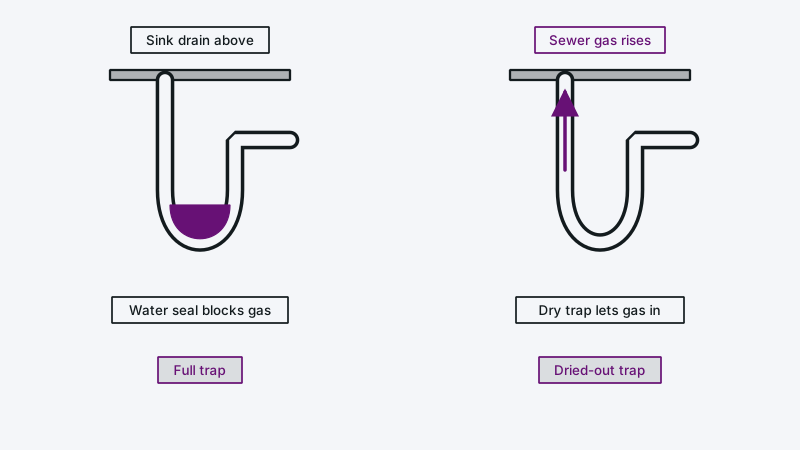
Four things account for most sewer smells: a dried-out drain trap, a vent that is blocked or absent, a toilet seal that has worked loose, or a cracked drain line. First, flush the seldom-used drains with a minute of running water and see whether the odor fades. If it holds, the trouble sits deeper in the sewer line or its vents and needs a plumber, who you can request on the quote page. The Lankershim Plumbing home page lists our other plumbing guides.
What causes a sewer smell in the house?
Likely culprits are a dry trap, a blocked vent, a failed toilet wax ring, a cracked drain or sewer line, and a sewer line that is backed up or full of roots. Every fixture has a trap, shaped like a U, whose standing water keeps gas out. Once that water disappears, the pipe is open to the sewer. It can vanish through evaporation, siphoning or a leak.
Reference sources add leaking drain or vent pipes and cracks in the foundation as ways gas can enter. The smell itself is a mix of gases, including hydrogen sulfide, which smells like rotten eggs, and sometimes ammonia and methane. Where the odor is strongest tells you a lot. A floor drain as the strongest spot suggests a dry trap. The toilet base suggests the seal. A smell that is equally strong everywhere suggests the line or the vents.
How do you get rid of the smell yourself?
Run water into every drain for about a minute, including floor drains, laundry standpipes, guest-bath sinks and tub overflows. That refills dry traps, which is the most common fix. Next, look at the toilet bases for rocking or staining around the flange, and confirm the cleanout caps are on. If the smell stays after refilling, stop and call a plumber.
Here is the order that finds most causes. First, refill every trap. Second, smell each drain and toilet base and record which is worst. Third, look for a damp spot or discoloration near a toilet or floor drain. Fourth, check that sink drains and overflow openings are not full of residue. Don't mix drain chemicals in a smelly drain, and don't pour bleach and cleaners together. If the cause is a seal or a vent, a plumber replaces it.
Can sewer smell in the house make you sick, and is it dangerous?
In nearly every case it is only a nuisance, yet high levels are dangerous. Reference sources say sewer gas in most homes is mainly an odor problem and rarely a serious risk. Hydrogen sulfide can irritate the eyes and airways at low levels, and prolonged low exposure may cause fatigue, headaches and dizziness. High concentrations can cause unconsciousness and death. Sewer gas can also burn.
Your nose gives limited protection. Hydrogen sulfide can be smelled at less than one part per billion, but at high levels it dulls the sense of smell, so a smell that fades does not prove the gas has cleared. If the smell is overwhelming, you feel dizzy or have a headache, or you smell it in a closed space like a pit, leave and call 911. Don't light flames or switch on sparking devices.
Is it sewer gas or natural gas?
Natural gas is given an added odor that many people describe as rotten eggs, so the two can be confused. If you are not sure, treat it as natural gas. Leave the building, skip switches and phones indoors, and phone SoCalGas from outside on 1-800-427-2200. Where anyone is at risk, dial 911 as well. A sewer smell is usually stronger at drains, and a gas smell near appliances or the meter.
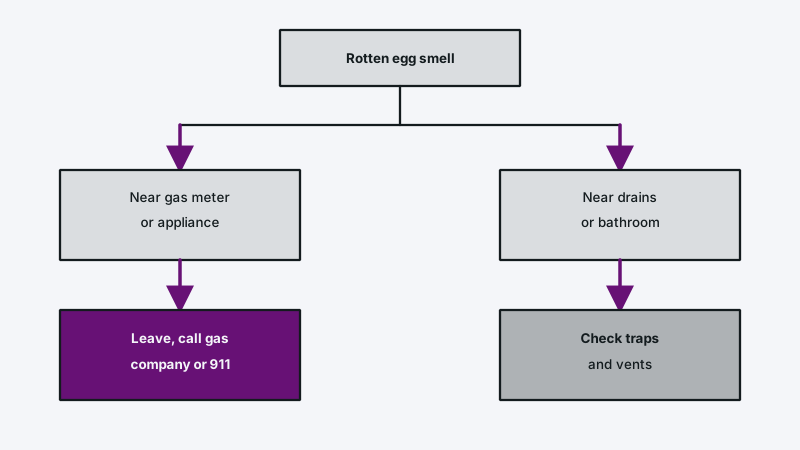
A plumber can tell them apart, and so can SoCalGas, which responds to gas smell reports. When you call, say where you smell it. Don't try to find a gas leak by flame. If the smell is at a floor drain near the furnace or water heater, tell the technician, since that location is a common spot for dry traps.
Why does the sewer smell come and go, or show up in cold weather?
An intermittent smell often means a trap that dries out, a vent that is partly blocked, or wind and pressure changes pulling gas through a weak point. Reference sources say floor drains near furnaces or water heaters are common culprits, since the water in an unused trap can evaporate. A furnace running in the cooler months can pull air through such a drain.
Burbank's winters are mild, so frost blocking a vent is unlikely here. Rain can matter. Heavy rain can load a sewer line and push gas toward weak points, and wet soil can show up cracked laterals, but we have not found a source for a fixed rule. A smell that returns after you refill every trap means keep looking. Write down when it happens, because the pattern helps the plumber.
How do tree roots get into a sewer line, and how do you remove them?
Roots seek out water and nutrients, and a hairline crack or loose joint in a drain pipe lets them in easily. Once inside they thicken, catch paper and grease and cause slow drains, gurgling and backups, and sometimes a sewer smell. Clay and cast iron lines from the 1940s to 1960s in Valley homes have many joints and face more risk.
Getting roots out of the main drain is a plumber's job. The plumber cuts them with a cable or flushes them with high-pressure water, and a camera reveals the pipe's state. Our page on hydro jetting explains the water method. Roots usually return if the crack stays, so repair or lining may be recommended. Chemical root killers are not a substitute for fixing the pipe.
How do you repair a sewer line?
The plumber finds the problem with a camera, then chooses a spot repair, a trenchless method or a replacement. Trenchless lining pulls a resin-soaked tube into the pipe and cures it in place. Pipe bursting drags fresh pipe through the old run. Both need little digging, and both depend on the pipe, its bends and its access points.
Sewer work needs a permit, and CSLB says permits for repairing structures come from your local building department. Burbank, Glendale and the LA city neighborhoods each handle their own. A repair under a street or sidewalk may need more. If your house was built before 1970, the line may be cast iron or clay, and our page on cast iron pipe replacement covers what replacement involves.
When should you call a plumber?
Get a plumber in if the smell lingers after refilling traps, if it is strong, if several fixtures drain slowly, if sewage backs up, or if wet spots or sinkholes appear in the yard. Phone at once for a backup, since waste can contaminate floors. Stop using water if drains are backing up. Leave the house for a strong smell with dizziness.
We'll line up a local plumber to inspect, put a camera down the line and write up a quote. Let us know when the smell began and where it is worst. For local help near you, see our pages on plumbers in Glendale and the other neighborhoods we cover, or begin at the Lankershim Plumbing home page.
Questions people ask
Why does a sewer odor show up in cold weather?
The usual cause is a dry trap or a problem with the vent. Reference sources note that floor drains near furnaces and water heaters are common culprits, since their trap water can evaporate. In Burbank, hard freezes are rare, so frost on a vent is unlikely. Refill every trap first, check the toilet bases, and bring in a plumber if the smell comes back.
Is breathing a sewer odor harmful to health?
It can at high levels. Low levels of hydrogen sulfide can irritate the eyes and airways, and long exposure may cause fatigue, headaches and dizziness. High levels can cause unconsciousness. In most homes the smell is a nuisance. If it is strong, or you feel unwell, ventilate, leave the space and get help. Call 911 in an emergency.
What makes the odor strongest at night or early morning?
Fixtures go unused overnight, so a trap with a slow leak or a worn seal can lose gas protection, and temperature and air movement change through the day. A smell that is worst in the morning often points to an unused drain or a vent issue. Run water in each drain before bed and note which one is strongest.
Does a sewer odor mean the main line is broken?
Possibly, though it should not be your first suspicion. A dry trap, a toilet seal or a vent problem is far more common. A broken line shows up as smells in several places, slow drains across the house, backups, or wet ground in the yard. A camera inspection tells you for sure.
References
- Sewer gas, causes and health effects (Wikipedia)
- Trap (plumbing), water seals and dry traps (Wikipedia)
- Hydrogen sulfide, odor threshold and exposure limits (Wikipedia)
- Cured-in-place pipe lining (Wikipedia)
- Pipe bursting (Wikipedia)
- California Contractors State License Board, building permit requirements
- SoCalGas, if you smell gas call 1-800-427-2200
Updated