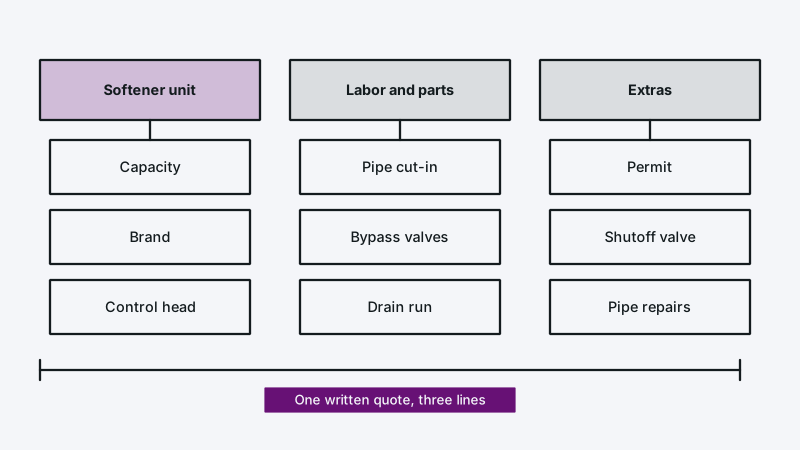
We do not print a dollar range on this page. The published figures we could check were not good enough to repeat, and a guessed number would mislead you. What we can give you is the structure of the price: which parts of a quote are fixed, which move with your house, and which questions expose a low offer that leaves things out. The real number comes from a written quote after a plumber sees the main, the drain and the water heater. Start with our water softener installation guide if you have not yet decided on a type.
What does water softener installation cost in Burbank?
Expect three parts in any quote: the softener, the labor and materials to hook it up, and whatever extras your house forces. Equipment cost shifts with capacity, brand and features. Labor shifts with access and the pipe being cut. Have each installer list all three amounts apart from one another, on paper.
That is a straight answer to how much it costs: it depends on those three lines, and anyone who names a figure before seeing your house is guessing or selling something. National cost guides publish ranges, but they mix small units with large ones, different regions and different scopes. Read them as a rough guide at most. Read the prices published by a few local businesses, ask them what each includes, and compare.
If you want a rough budget, ask three installers for a written quote on the same specification: the same capacity, the same bypass, the same drain and the same outdoor-line split. Differences between those quotes then show real differences in labor and margin, not differences in what is being sold.
What pushes the price up or down?
Five things move the number most: unit capacity, how the main and drain are laid out, the pipe material, a split for outdoor lines, and permit needs, plus any repair the plumber uncovers. A garage main with a floor drain nearby is the cheap case. A buried main or a long drain run sits at the high end.
Go through them one by one:
- Capacity and features. A bigger tank and a metered control head cost more than a basic timer unit. Size comes from your hardness and household use. The USGS calls water above 180 mg/L very hard, so check your utility's report before you pay for capacity you do not need.
- Pipe material. Cutting into copper or PEX is routine. Old galvanized steel can mean extra fittings, transition pieces and a risk of leaks starting nearby. If the main is in poor shape, replacing a section may beat working around it. See cost to repipe a house for that decision.
- Drain. Regeneration water must reach the sewer by a legal route with an air gap. A floor drain next to the unit costs little. One at the opposite end of the house, behind a wall, costs more.
- Outdoor split. Keeping hose bibs and irrigation off the softened line takes added pipe and a tee. It is worth doing, and the quote should show it as its own line.
- Shut-off valves. A main shut-off that will not close all the way has to be replaced first. Ask whether the quote covers it.
- Permits. Some cities require one to connect treatment equipment. We have not verified a Burbank rule, so confirm with the Building Division and make sure the quote states who pulls the permit and who pays the fee.
How do I compare softener quotes?
Line the quotes up and compare six points on each: the unit's make, model and capacity, the flow rating, what the labor line covers, whether outdoor lines are bypassed, and the plan if the pipe proves worse than expected. A low quote missing the bypass or drain is not actually low.
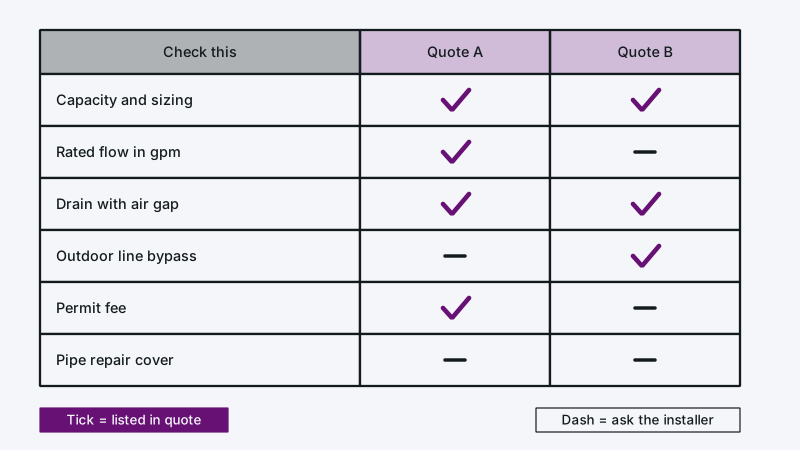
Put these questions to each installer:
- What is the unit's capacity, and how was it sized for my hardness and household?
- What flow rate in gallons per minute does it carry, and can two showers and a washer run at once?
- Does the price include the drain connection with an air gap, and where does it run?
- Is an outdoor and irrigation bypass part of the job?
- If a permit is required, who pulls it, and is that fee inside the quote?
- What happens to the price if the pipe or shut-off valve needs work?
- How do I buy or receive salt, and what warranty does the maker give?
For that last one, read the manufacturer's own warranty document. We describe no warranty here, because the terms belong to the maker.
What about Kinetico, Culligan, Costco and other brands?
A brand name changes the equipment, and sometimes how labor is sold. Some sellers bundle installation with the unit they supply, some sell only equipment and leave the plumber search to you, and some rent or lease. Every one publishes its own pricing, so we do not repeat any here. Request an itemized written quote from each and set it against a plumber's.
Retail and big-box offers often advertise an installed price built on a standard setup: drain close by, pipe within reach, nothing odd. A cramped main or a faraway drain can push the final figure up. Find out what counts as standard and what is extra.
Brand-direct dealers may use their own installers and their own specification. That is not a problem if the quote is itemized. It becomes a problem when you cannot tell what you are paying for the unit and what for the work. A line that says only "installation included" is not enough to compare.
Water-quality dealers also sell salt-free systems and combination setups. Those have a different price and do not do the same job: ion exchange removes hardness, while template-assisted crystallization changes how scale forms and leaves the minerals in the water. Make sure every quote you compare is for the same type.
What about a loop installation or a calculator?
A loop installation plumbs the softener as a loop off the main, so it can come out of service without cutting the line. A quick calculator can add up parts but cannot see your drain or pipe. Build a rough budget by line item with one, then swap the guesses for real quotes.
A calculator worth trusting asks about unit capacity, bathroom count, pipe type, drain distance and whether you want an outdoor split. One that wants only your zip code is a lead form in disguise.
The loop comes down to layout. Plenty of installs already include a bypass valve set that does the same thing: turn a handle and water goes around the softener. A larger loop with extra valves and unions eases servicing and adds to the parts bill.
How do I keep the running costs in view?
Buying and installing the unit is one price. Salt, regeneration water and the odd repair are another. A metered unit that regenerates only on demand burns less salt than a timer unit. Weigh running costs when you choose, and ask the installer how often the unit will regenerate at your hardness.
Softening also repays itself through what it protects. Scale coats water heater elements and the tank bottom, and Wikipedia's hard water entry says softening is often recommended for water feeding domestic hot water systems. If scale is killing your heater, the water heater replacement cost page and the when to replace a water heater guide cover the other side of the math.
Comfortable with tools? The DIY softener page says which parts you can take on. A DIY job takes labor out of the quote, though the risk of a leak at the main stays.
How do I get a written quote?
Give us the house age, pipe material, where the main comes in, where the water heater sits, the household and bathroom count, and the hardness number from your water quality report on our quote page. A visit gets arranged, and a local plumber inspects the main and drain before pricing the job.
You receive the quote on paper before any work starts. For other jobs around the house, start from Lankershim Plumbing. You can also look at whole-house softener sizing before calling.
Questions people ask
What does a plumber bill for a softener install?
The labor covers cutting into the main, fitting a bypass, running the drain and starting the unit, with materials on top. The total turns on access, pipe type and drain distance, so houses differ. Insist on a written quote that splits labor from equipment before you say yes.
Which costs less: buying the unit and hiring a plumber, or buying it installed?
Either can win. A bundle is easy but may bury the labor price. Buying separately lets you compare each part. In both cases, get itemized quotes with the same capacity, bypass and drain so the comparison holds up.
Does the price include salt and a permit?
The first bags of salt rarely add much, and a permit may or may not be bundled in. Do not assume. Have the quote say whether Burbank needs a permit, who obtains it, and whether the fee sits inside the total.
Is a salt-free system cheaper to install?
It can be simpler, since many salt-free conditioners need no drain and no power, but it solves a different problem. They change how scale forms and leave minerals in the water, while ion exchange removes hardness. Choose by what you need to fix, then compare prices.
What is the typical duration of a softener installation?
A standard setup takes a few hours. Access to the main, the drain route and the pipe material set the pace. The plumber can estimate once the layout is in view, and the quote should state how long the water stays off.
Does someone have to be home for the work?
Yes, to point out the main shut-off, approve the unit's location and join the final walkthrough. Agree the plan at booking, including how the plumber gets into the garage or utility area.
References
Updated