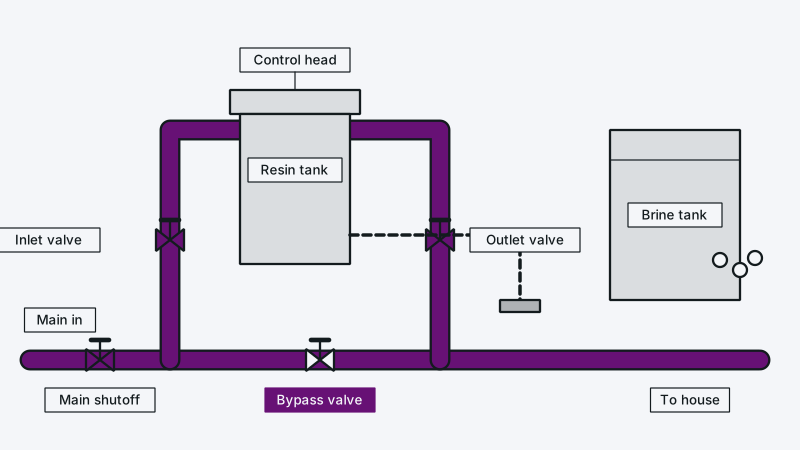
Installing a water softener yourself is a realistic weekend job when the main is copper or PEX, the shut-off valve closes fully, and a drain sits within reach. It becomes a bad idea when the pipe is old steel or when something in the sequence goes wrong with the water off. The notes below follow the order a plumber works in. They sit under our water softener installation guide, which covers the job when you would rather have it done for you.
Can I install a water softener myself?
Yes, provided you can cut and join your pipe type, close the main, run a drain through an air gap and follow the maker's manual. Bring in a plumber if the pipe is galvanized steel, the main shut-off will not close, local rules need a permit you cannot pull, or this is your first attempt and nobody is around to ask.
Be honest about two things before you buy. First, the unit is the easy part. The cut into the main is where leaks begin. Second, the manual for your model overrides anything general on this page, including the sequence and the settings.
Try this first: close the main, open a faucet and see whether the flow stops. A steady trickle means the shut-off is failing, and you would be cutting into a live pipe. Replace that valve before anything else, or hire the job out.
Also check the house. Many San Fernando Valley houses from the 1940s to 1960s still have galvanized supply pipe. Reference sources note that galvanized pipe rusts from the inside, so aged sections can be brittle, crumble under the cutter and leak at threaded joints once disturbed. Treat that as a cue to pass the work to a plumber rather than push ahead.
What do I need before I start?
Gather the softener with its bypass valve and install kit, pipe and fittings that match your main, a cutter suited to your pipe, a drain hose and air-gap fitting, a level, thread tape or push-fit connectors, a bucket, towels and a nearby outlet. Pull up your utility's water report to learn your hardness before choosing a size.
Sizing is arithmetic, not guesswork. Hardness comes from the report, and the USGS calls water above 180 mg/L very hard. Sales sheets quote grains, so divide milligrams per liter by 17.1 to get grains per gallon, then match it to the maker's sizing chart. Not sure the unit fits your household? Whole-house water softener installation explains capacity and flow rating.
The tools depend on the pipe. Copper takes a tubing cutter plus fittings that are soldered or push-to-connect. PEX takes a cutter and crimp or clamp tools, or push fittings. Keep the hacksaw off a main line, since shavings foul valves downstream.
Choose the location beforehand. It needs a level floor, room to lift a bag of salt into the brine tank, and a drain nearby. If you are unsure which type to buy, salt-based water softener installation is worth reading first.
What are the steps to install it?
The order is: close the main and open a tap to empty the line, mark and cut the cold main, attach the bypass with the inlet and outlet connections, route the drain across an air gap, connect power to the control head, fill the brine tank, enter the hardness, then bring water back slowly and inspect each joint for drips.
The sequence, with the reasoning:
- Shut off and drain. Close the main, then open the highest and lowest taps so the pipes empty. Shut the water heater supply as well, and on an electric heater flip its breaker so the elements never run dry.
- Position the unit. Place it level with inlet and outlet facing the correct way. Swapping them is a classic blunder. The arrows on the valve show flow direction.
- Cut and connect. Cut the pipe, deburr the edge, and join inlet and outlet through the bypass valve. The bypass lets you isolate the unit later.
- Run the drain. Rinse water has to reach a legal drain across an air gap, an open space between hose and drain that stops sewer water siphoning back.
- Power and salt. Plug in the control head, pour salt into the brine tank and add water if the maker says to.
- Program. Enter your hardness and the time of day, then follow the manual for the first regeneration.
- Restore water slowly. Open the main partway with a tap open so air can escape, then check every fitting. Keep towels near and look once more after an hour.
Leave the bypass in its bypass setting until the lines are flushed, then move it to service. Do the first regeneration the way the maker directs.
What are the common mistakes?
Look out for reversed inlet and outlet, a drain with no air gap, a bypass left open so water skips treatment, overtightened plastic fittings, outdoor lines forgotten on hard water, and hacksaw cuts that leave shavings in the valves. Most appear within the first hour or the first week.

Some extras. A control head set to the wrong hardness either wastes salt or lets hard water through. A kinked or uphill drain hose makes the unit back up during regeneration. Forcing an old shut-off valve can snap it or start a drip.
Sodium is the other consideration. Ion exchange swaps hardness for sodium, and Wikipedia's water softening entry cites a study with softened water averaging 278 mg/L sodium. The EPA considers sodium in drinking water unlikely to cause adverse effects, but if you are on a low-sodium diet, plan a drinking tap on an unsoftened line and ask your doctor.
Test afterward. Dip a hardness strip at a faucet. A hard reading means checking the bypass handle and the hardness setting before blaming the unit.
Where does the law say I must stop?
Brine goes to the sewer, so some California communities restrict salt-based softeners, and some cities want a permit to hook up treatment equipment. We have not verified a specific Burbank rule. Ask the Burbank Building Division before you start, or LADBS if you live in an LA city neighborhood. Gas piping and new electrical circuits are regulated work the law keeps for specialist trades, so leave them to a plumber or electrician.
Keep away from gas lines during a softener install, and do not run new electrical circuits unless the law allows it. A softener needs nothing more than a plug into an existing outlet. With a gas water heater nearby, keep the softener and salt clear of the heater and its vent, and never block combustion air.
Gas odor at any stage means leaving the building. Once you are outdoors, phone SoCalGas (1-800-427-2200), and dial 911 if anyone faces danger.
Where a pressure reducing valve exists, put the softener after it, never before. If the water heater is strapped for earthquakes, leave the straps alone while you work nearby.
What about scale I already have?
New scale is what a softener prevents. Existing deposits do not clear quickly. Soft water may loosen some over time, while fixtures and glass still need hand cleaning. Vinegar and citric acid methods, and the finishes to keep them off, are covered in our hard water scale removal guide.
Scale packed inside pipes and a water heater is another story. Flushing handles sediment, yet hardened scale does not always come out. When hot water pressure has dropped, read why water pressure is low before putting a treatment unit on a restricted line.
When should I hand the job to a plumber?
Give it to a pro when the main is galvanized steel, the shut-off will not hold, no drain is within reach, you want outdoor lines split off, or the permit rules are unclear to you. A local plumber visits, and a written quote reaches you before work starts.
Fill in the quote page and we schedule the visit. The price guide shows what a softener quote contains, so you know what you are comparing, and Lankershim Plumbing lists the other jobs we line up around Burbank and the Valley.
Questions people ask
How much time does a DIY softener install take?
Budget a long afternoon up to a full day for a first attempt: emptying the line, cutting in, fitting the bypass, running the drain and testing for leaks. A plumber moves faster from practice. Never hurry the leak check, and look again an hour after water returns.
What should I ask if I hire out the job instead?
Find out how the unit gets sized, where the drain runs and whether it has an air gap, whether outdoor lines stay on hard water, any permit requirement, and what the quote covers should the pipe or shut-off valve need repair. Put the answers in writing.
Should I be home if a plumber installs the softener?
Yes, to point out the main shut-off, approve the unit's location and join the final walkthrough. The water is shut for a stretch of the visit, and access to the garage or utility area is needed. Settle the plan when you book.
Does a DIY install void the warranty?
It can, depending on the maker. Some require installation by a plumber for the warranty to stand, and some accept a homeowner install that follows the manual. Read the warranty document for your model before you buy, and keep your receipts and photos of the install.
Is a permit needed for a softener?
That varies by city. Some want a plumbing permit before treatment equipment is tied to the water line. We have not verified a Burbank rule, so phone the Burbank Building Division, or LADBS for an LA city address, before starting.
Can I install a softener on galvanized pipe?
Possible, but risky. Galvanized steel corrodes inside, and it can crack or leak once cut or disturbed, while threaded joints may fail after being turned. A plumber can judge the section, replace it where needed and make a clean transition to the softener. If the pipe is in bad shape, repiping may be the true fix.
References
Updated