
Installing a softener is plumbing work driven by water chemistry. When scale crusts your fixtures, wears down your water heater and fogs your glassware, a softener on the main line treats every tap in the house. We set up the visit: a local plumber arrives, looks over the main, the drain route, the power supply and the space, and hands you a written quote ahead of any work. Request a quote here or keep reading to see what the job involves.
What does a water softener installation plumber do?
The plumber closes and empties the main, tees the softener into the cold line through a bypass, runs a drain for the regeneration water, wires power to the control head, loads the brine tank, enters the hardness and starts a first regeneration. After that the water returns and each joint gets a leak check.
The bulk of the work happens on the pipe. Fittings depend on the main's material, copper, PEX or galvanized steel, and postwar Valley houses often have aging pipe in the garage. That is where careless work goes wrong, and it is why owners hire a plumber. A bypass valve set also lets you service the unit later without cutting off the house.
The drain connection needs an air gap, so that sewage cannot siphon backward into the softener. The plumber also chooses which lines stay on hard water, typically outdoor spigots and irrigation, so you are not softening water for the lawn.
Home softener installation, softener system installation and the plumbing for a water softener are all names for this work. The loop installation people search for is the bypass arrangement above: water can pass through the softener or around it.
How does a softener fix hard water scale?
A salt-based softener trades calcium and magnesium for sodium on resin beads, then recharges those beads with brine from the salt tank. With the dissolved hardness gone, the water no longer leaves limescale in the water heater, on fixtures or inside hot lines. Salt-free conditioners take another route and alter how scale forms.
Scale is mostly calcium carbonate. It drops out when water is heated or evaporates, so the hot side suffers first. The USGS describes heated hard water leaving solid deposits that narrow pipes over time, and Wikipedia's hard water entry says softening is often recommended for domestic hot water systems.
The two treatment families work differently. Ion exchange takes the hardness out. Template assisted crystallization, the salt-free method, converts it to tiny suspended crystals and leaves the minerals in. Results vary, and deposits can still build up wherever water dries. For more on the first type, see salt-based water softener installation.
Whatever system you consider, start with your utility's water quality report for the real hardness figure. Burbank Water and Power publishes one. The USGS labels water above 180 mg/L very hard, and roughly 17.1 mg/L equals one grain per gallon, which lets you convert.
What affects the price of a softener installation?
Cost moves with the unit's capacity, how easily the main can be reached, the pipe material, the distance to a drain, whether outdoor lines are split off, any permit and whatever repairs turn up. We print no dollar figure here because we could not source one we trust.
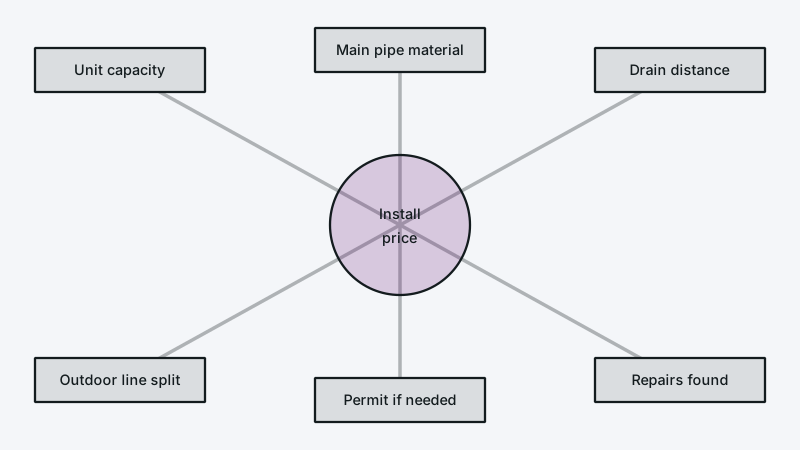
A good written quote separates equipment, labor and extras. Our water softener installation price guide shows how to split a quote into parts and what to ask when you compare a big-box store, a brand dealer and a plumber.
The garage pipe matters more than most owners expect. A clean copper or PEX main with a floor drain beside it is a short, routine job. Old galvanized steel, a stiff shut-off valve or a drain at the opposite end of the house adds parts and hours. The plumber should flag that in the quote, before the work, not after.
What are the signs you need a softener?
Watch for white crust on faucets and showerheads, cloudy glassware, soap scum that will not rinse, a rumbling water heater, and scale flakes in aerators. Your utility's report settles it: the USGS classes a hardness reading above 180 mg/L as very hard. One or two signs alone may not justify a whole-house unit.
When scale sits on only a few fixtures, regular cleaning can carry you for now. The hard water scale removal guide explains what works on faucets, shower glass and heads. A softener pays off when scale appears everywhere, attacks your appliances, or wears you out with the weekly scrub.
Not every hardness problem calls for a softener. Hardness is a nuisance rather than a health hazard, and the EPA treats its secondary standards as non-enforceable guidelines. Blue-green stains may be copper corrosion and brown stains may be iron, neither of which a softener is sure to fix.
Is a shower head filter or a softener filter the same thing?
No. Softeners take hardness out of water. Filters, showerhead filters included, mostly catch particles or chemicals like chlorine and do not soften in any real sense. Likewise, a main-line softener does nothing for chlorine, chloramine or taste. The two tackle different problems, and some homes run both.
For questions about a particular brand, such as Aquasana, Whirlpool, RainSoft or Culligan, the maker's own site and installation manual are the final word on that model. Some brands sell salt-based units and others sell salt-free conditioners, so confirm which type a model is before comparing. The manual's diagrams show the plumbing layout a plumber follows for the main, bypass and drain.
Weighing a tank-style unit against a larger whole-house system? Whole-house water softener installation explains capacity and flow.
Can I install a softener myself?
A handy owner can, with the manufacturer's manual in hand. The hazards are leaks from cutting into the main, a drain lacking an air gap, a reversed inlet and outlet, and a bypass accidentally left open. Old galvanized pipe, or a main that will not close fully, is the cue to hire a plumber. Our DIY softener page lays out the steps and the limits.
Local rules count too. Brine discharge to the sewer leads some California communities to restrict salt-based softeners, and some cities require a permit to connect treatment equipment to the water line. We have not verified a Burbank rule, so check with the Burbank Building Division before you begin, or with LADBS if your home sits in an LA city neighborhood of the Valley.
How does a softener visit work with us?
On the quote page, include the street address, how old the house is, what the pipes are made of, the headcount and bathroom count, and the hardness figure if you have one. A visit follows. The local plumber measures the layout, tests the shut-off valve and writes up a quote before starting.
The local plumbers we arrange cover Burbank and the nearby Valley, and the neighborhoods page lists the areas. Other plumbing can ride along on the same visit, such as a failing water heater or a pressure problem. See Lankershim Plumbing for the jobs we arrange, or why water pressure is low.
Questions people ask
How many hours does the plumber's installation work take?
With an accessible main and a nearby drain, expect a few hours for emptying the line, fitting the bypass, running the drain and programming the unit. Old pipe, a stiff shut-off valve or a long drain run stretches that. The written quote should carry an estimate.
What should I check with a plumber before agreeing to the install?
Ask how the unit was sized, its flow rating, where the drain goes, whether outdoor lines stay on hard water, whether Burbank requires a permit, and what the quote includes if the pipe needs work. Have the answers written into the quote before anything begins.
Must I be at home during the installation?
Somebody should be present at the outset to point out the main shut-off and agree on the unit's spot, and again at the end for the walkthrough. Water is off for a while during the visit. Settle garage or utility area access when you book.
Does a water softener shower head installation work?
A softener installs on the main line, not on the showerhead. A showerhead filter is a different product that mainly treats chlorine and particles, and it does not soften water the way a whole-house unit does. If your problem is scale, treat the water, then clean the head.
Does a softener lower water pressure?
At most a small drop, from a correctly sized unit, since water passes through resin and a control valve. Undersizing can leave showers feeling weak. Compare the rated flow with what you run simultaneously. If pressure was low before, deal with that cause first.
Can I put a softener on a tankless water heater line?
Often yes, and it helps because scale on the heat exchanger is a common failure. Check the water heater maker's requirements and the softener's flow rating before you buy, since tankless units can draw a lot of flow. The plumber can confirm compatibility in the quote.
In this section
- Removing hard water scale
How to remove hard water scale from faucets, glass, showerheads and a water heater, which cleaners are safe on which surfaces, and how to…
- Salt based water softener
How a salt-based water softener is installed in a Burbank home: where it goes, what plumbing it needs, the drain and salt questions, and…
- Water softeners and treatment
How to install a water softener yourself in a Burbank home: the order of steps, the tools, the drain rule, and where to stop and hand the…
- Costs
What decides the price of water softener installation in Burbank, how to read a quote line by line, and how brand, loop and big-box offers…
- Whole-house water softener installation
Whole-house water softener installation in Burbank: sizing by hardness and household, flow rate, where the unit tees in, and what a…
References
Updated