Calabasas is a separate city from Los Angeles. It incorporated on April 5, 1991, and rests in the foothills of the Santa Monica and Santa Susana mountains at the far southwest corner of the San Fernando Valley. So it has a different water supplier and permit office than the rest of our area. The areas page shows how it fits with Burbank and the Valley.
Who supplies water in Calabasas, and how hard is it?
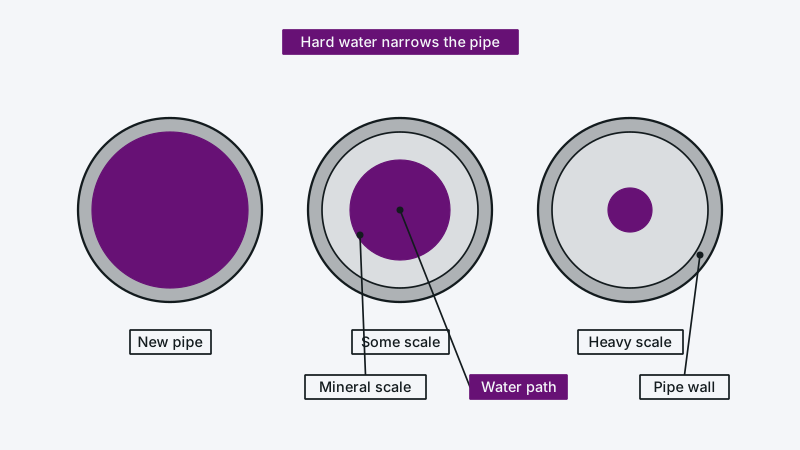
Las Virgenes Municipal Water District supplies Calabasas, and it reports total hardness of 119 to 176 ppm across its delivery system, averaging 142 ppm. That works out to roughly 8.3 grains per gallon, using the standard 17.1 ppm conversion. It is moderately hard to hard water.
By the district's own account, all its water is imported. It has no local drinking water sources, and supply comes through the State Water Project and the Metropolitan Water District of Southern California. Hardness at that level still leaves scale in heaters, kettles and shower heads.
What to do about a hardness number like that:
- Flush a tank water heater yearly and inspect the anode and relief valve.
- Clean aerators and shower heads once flow thins.
- Pick a softener only after reading the district's report, since a whole-house unit costs real money. Our guides to water softener installation and softener installation prices cover the options.
What is different about hillside and canyon lots?
Foothill lots affect plumbing in three ways: longer pipe runs from the street, pressure that shifts with elevation, and awkward access for equipment. Calabasas sits at about 928 feet, and the city is described as foothill terrain rather than a flat grid.
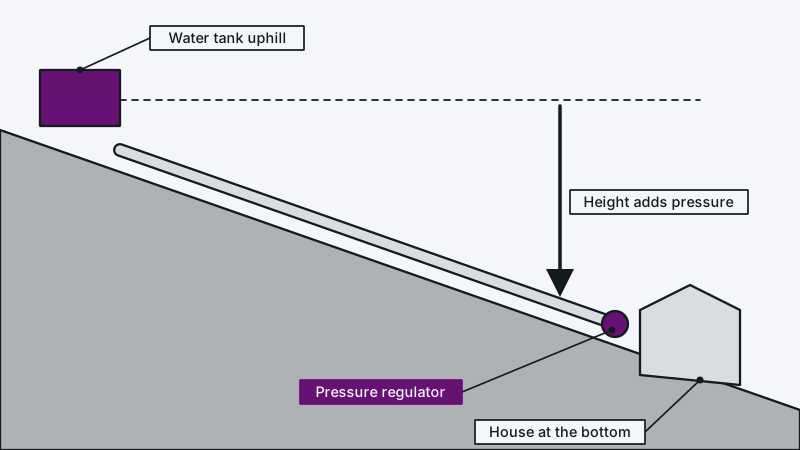
A house set well back from the street may have a long supply line, and long lines cost more to replace and are harder to trace when they leak. A house above the street may see lower pressure at the tap, while one below may see high pressure that strains fixtures. Low water pressure has a page of its own.
A leak in a long buried line often shows up first on the water bill. Water running under a driveway or retaining wall calls for detection equipment, and underground water leak detection explains the methods.
Are some Calabasas homes on septic systems?
Some are. Where there is no public sewer, a property uses an onsite wastewater treatment system, commonly called a septic system, and repairs or replacement go through LA County Public Health, as the county's application package for those systems shows. The county's sewer permit page also distinguishes incorporated cities from unincorporated areas.
We cannot tell you which streets are on septic. Your title or the city can answer that, and a tank pumping record is a hint. A plumber can deal with the pipe running from the house to the tank, but the tank and leach field are regulated, and replacing them needs county approval. Suspect septic trouble if drains run slow throughout the house, gurgle, or the yard stays wet. Call a professional instead of opening the tank yourself.
For routine drain clearing, what a plumber charges to unclog a sink is where to start.
What kind of homes are in Calabasas?
Mostly owner-occupied. The 2020 census counted 9,289 housing units, with about 70 percent of occupied homes owner-occupied and an average household of 2.63 people, per Wikipedia's summary of census data. Since the city incorporated in 1991, much of its housing is newer than the Valley's postwar tracts.
We cannot list pipe materials street by street. As a general pattern, homes built from the 1980s onward more often have copper or plastic supply lines than galvanized steel, but that is a tendency, not a rule, and only a plumber looking at the pipes can confirm it. Owners of larger houses often ask about long hot water waits, recirculation, tankless heaters and gas lines for outdoor kitchens. See tankless water heater installation prices and gas line installation.
Summers are hot and dry, with about 17.8 inches of rain a year, so irrigation lines work hard. Their leaks appear as soggy spots or a rising bill, and sprinkler system leak detection is the page for that.
What does plumbing cost in Calabasas?
Our quotes come in writing once we have the details. As a guide from this site's cost pages, a water heater replacement runs about $1,500 to $6,500, a repipe about $1,500 to $15,000 and a gas line job about $120 to $1,350. Hillside access, long runs and septic work all push toward the upper end.
Treat these as guides, not offers. Ask the quote to list what it covers: permit, haul-away, expansion tank, seismic straps. Tank and tankless numbers are in water heater replacement costs.
Which permit office applies in Calabasas?
The City of Calabasas Building and Safety Division, not LADBS. The city's own information puts plumbing work, replacing a water heater included, on its list of work needing a permit, and its forms page has a plumbing permit application. Fees and timing vary, so check the current schedule with the city.
State rules also say water heaters need earthquake bracing. Where a home sits in an unincorporated pocket with a Calabasas mailing address, the county may be the authority instead, so confirm which jurisdiction your parcel is in. The water heater permit guide sets out the usual steps.
How do you book a plumber in Calabasas?
Submit details through the quote page or call during our hours, Monday through Friday, 9am to 5pm. Give us the street, whether the property is on public sewer or septic, and what you are seeing. We line up a local plumber, and the written quote arrives ahead of any work. The Lankershim Plumbing home page has the full list of services.
Questions people ask
How hard is the water in Calabasas?
Moderately hard to hard. Las Virgenes Municipal Water District reports total hardness between 119 and 176 ppm, averaging 142 ppm, near 8.3 grains per gallon. Over time scale builds up in water heaters and fixtures. Read the district's current report before buying a softener.
Does Calabasas use LADWP?
No. Las Virgenes Municipal Water District supplies Calabasas, using only imported water from the State Water Project that arrives through the Metropolitan Water District. Your bill and your water quality report come from the district, not from the Department of Water and Power.
Is a permit required for a water heater swap in Calabasas?
Yes. The City of Calabasas counts plumbing work like a water heater swap as needing a permit from its Building and Safety Division. A plumber normally pulls it. Ask for the permit and the seismic bracing to be written into the quote.
Who handles septic problems in Calabasas?
LA County Public Health permits septic repair and replacement where public sewer is absent. Call a professional instead of opening the tank. A local plumber can be arranged for the house-side pipes, and the county decides what the tank and field need.
References
Updated