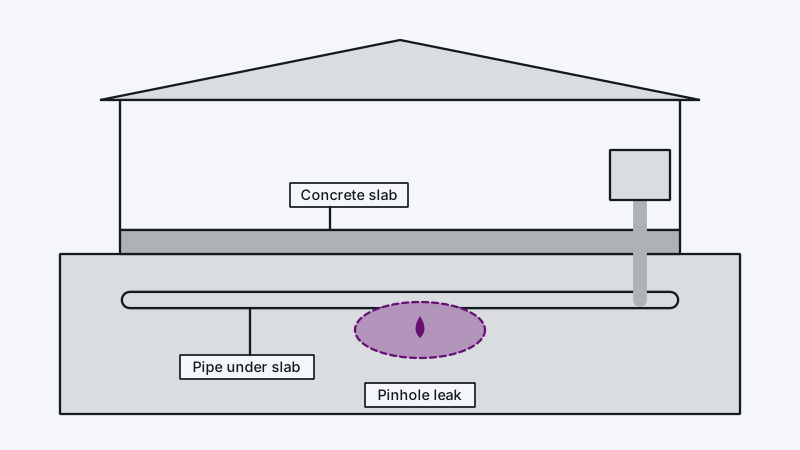
Patch the single leak when this is your first and the remaining pipe is sound. Repipe when the lines are old, corroded or have leaked before. A spot repair is cheaper now; a repipe costs more but stops the cycle. A leak detection visit normally settles it. If you are still unsure what is wrong, begin with our leaks and burst pipes guide.
What is the difference between a slab leak repair and a repipe?
A slab leak repair fixes the one failed section of a pipe running in or under the concrete floor. A repipe swaps out the supply lines, typically with new pipe routed through the attic and walls so the slab is left shut. The first is a patch for one failure; the second retires the whole set of lines behind it.
There are four ways to handle a slab leak, and published guides agree on how they rank by cost:
- Spot repair through the slab. The concrete above the leak is cut, the section is replaced and the floor is patched. Flooring restoration is often extra.
- Reroute. The failed line is abandoned and a new one runs through the attic or walls to the fixture. The slab stays intact.
- Tunneling. Access is dug from outside to reach the pipe under the slab, which can suit homes with finished floors you do not want cut.
- Epoxy lining or a full repipe. Lining coats the inside of pipe that is intact but leaking in small spots. A repipe swaps the lines for new ones.
Ask which one suits your layout, and the reason.
How do you know it is a slab leak and not something else?
The first sign is water you cannot account for: a bill that jumped, a trickling sound while everything is off, a hot patch on the floor over a hot line, or damp baseboards and carpet along a wall. Before booking anything, test the meter. Close every outlet, write down the reading, leave it two hours and check again.
EPA WaterSense says any change on the meter probably means a leak, but the test cannot tell you where. A toilet, an irrigation line or a wall pipe could be the culprit instead of the slab. Finding it is a separate job, done with listening equipment, pressure testing and sometimes thermal imaging. Our pages on slab leak detection and acoustic leak detection cover how those work. Detection is charged separately, though some plumbers deduct it from the repair bill when you proceed.
If water is coming up through the floor right now, close the main shutoff valve first and call for help.
When does a repipe make more sense than a repair?
Choose a repipe when the pipe is the problem, not just one spot on it. Two or more leaks in one house, lines nearing retirement, a material with a poor record and finished floors you want to protect all push the same way. A single pinhole in otherwise healthy pipe points toward a repair.
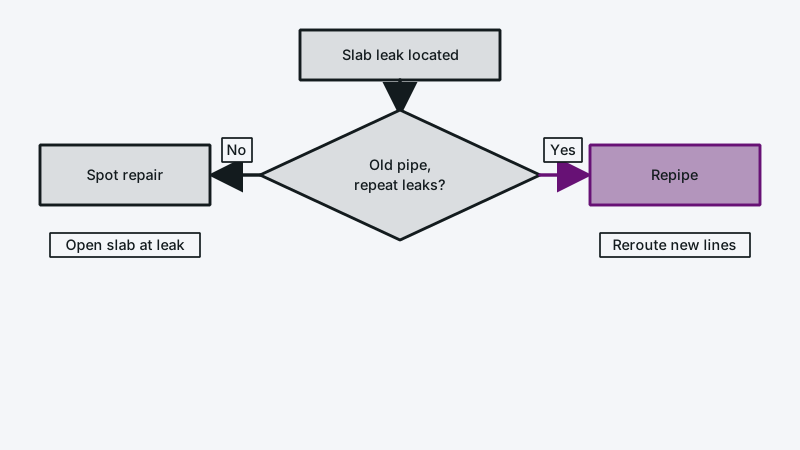
General rules from the published guides, to be checked against your house by a plumber:
- First leak, healthy pipe, newer home: a spot repair, or a reroute of that one line.
- Repeat leaks on different lines: a repipe, because the next failure is a matter of time.
- Polybutylene pipe: Wikipedia notes this plastic went into several million North American homes between roughly 1978 and 1997, and that chlorine and chloramine in municipal water degrade it. Burbank Water and Power's homepage mentions a chloramine boosting system at three of its reservoirs, so tell the plumber what pipe you have. Building codes no longer accept polybutylene.
- Copper that has failed in several places, or galvanized lines choked with scale: a repipe.
Many Valley homes were built after the war on concrete slabs, so an older house with its original copper is a realistic candidate. Our guide to repiping a whole house explains the job, and copper versus PEX covers the material choice.
What does slab leak repair or a repipe cost in Burbank?
National guides list a spot repair at roughly $500 to $2,000, a reroute at $1,500 to $4,000, tunneling from $2,000 up to $6,000, and an overhead whole-home repipe between $6,000 and $15,000. Detection costs $150 to $400. None of this is a Burbank price. That comes only as a written quote once someone has seen the house.
What moves the number:
- Access. Leaks under kitchen islands, load-bearing walls or tile cost more to reach.
- Pipe material and age. Old or failing pipe pushes toward the larger job.
- Number of leaks. One leak and four leaks are different projects.
- Foundation type. Post-tension slabs make cutting concrete riskier, which can favor a reroute.
- Restoration. Concrete patching, flooring and drywall are often billed separately; check if they are in the quote.
- Permit. Repiping generally needs a permit from your building department. Find out who applies for it and if the fee is included.
For more detail see concrete slab leak repair cost and the cost to repipe a house.
Does slab leak repair differ by city, or for a concrete roof slab?
The leak behaves the same anywhere, but permits, prices and utility rules change by city. Searches for slab leak repair in Encinitas, Fullerton, Richardson, Oklahoma City, Frisco or McKinney show local prices that do not apply in Burbank. We arrange visits in Burbank and the San Fernando Valley, so judge a Burbank house by a Burbank quote.
Two related searches deserve a straight answer:
- A leak under the slab. The same four options apply. Tunneling and rerouting exist because the pipe sits below the concrete.
- A concrete roof slab leak. Water coming through a flat concrete roof is usually a waterproofing problem, not a supply pipe. That is work for a roofing or waterproofing contractor, though a plumber can rule out a pipe if the water shows up only after you run a fixture.
What is the best way to repipe a slab house?
For a slab house the usual approach is an overhead repipe. New lines run through the attic and drop inside the walls to each fixture, and the old under-slab lines are capped and abandoned. That avoids cutting concrete. Drywall is opened at the fixture drops and patched afterward, so ask how the patching is handled.
Before choosing, get a written scope naming the pipe material, the number of fixtures covered, whether old lines are capped, who handles permit and inspection, and the finishing work that stays with you, paint for example. A clear scope makes repair and repipe quotes easy to compare side by side.
Questions people ask
How long does slab leak repair or a repipe take?
Published guides describe a spot repair or reroute as one to two days of work. Tunneling can stretch to several days. A whole-house repipe usually runs three to five days with drywall patching and finishing on top. Your quote should include a schedule for your house, including the hours the water is shut off.
Should I fix the slab leak first and repipe later?
If the leak is your first and the pipes test healthy, a repair now is reasonable. If the plumber sees corrosion or a problem material, ask for both prices side by side. A cheaper repair can cost more over several years if the next leak follows. Written numbers for both options let you decide with the facts.
What should I ask before I hire someone for slab leak work?
Find out if the leak was located with equipment or guessed, if the price covers the permit and floor restoration, which pipe material goes in, and how long the water stays off. Look the contractor up with the state licensing board and get everything on paper. Ask how a second leak next to the first would be handled.
Do I need to be home during the work?
Be there at the start, pointing out the main shutoff and approving access, and again at the end to look over the result. Between those visits many homeowners leave the plumber to work, though you lose water for part of each day on a repipe. Plan for that.
Will insurance pay for a slab leak?
That varies with the policy and the cause. Some cover the water damage but not the pipe, and some exclude leaks under the foundation. Read the wording, contact your insurer ahead of the work, and hold on to photos and the detection report. Our page on whether a burst pipe is covered by insurance lists what to ask.
To get moving, request a quote and a visit will be arranged. The Burbank plumber home page lists everything we cover.
References
Updated