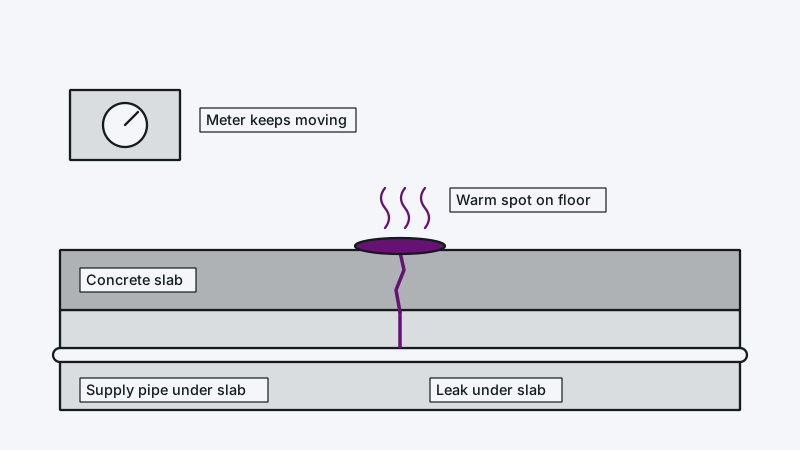
Water escaping from a supply or drain pipe buried under or inside the foundation is what people call a slab leak. The way to locate one is with listening gear, pressure gauges and heat scans, never a guess. The first clues tend to appear on the bill, the floor and the meter well before any puddle. It belongs to our leaks and burst pipes section and concentrates on the search, since an exact location is what keeps the repair small.
How do you know if you have a slab leak?
Watch for a bill that rises although nobody is using more, a meter creeping along with every fixture shut, a hot spot underfoot, running water audible in a silent house, and flooring that is damp or lifting. A single sign justifies a test. Two or three at once make a slab leak probable.
Leaks on a hot line are the easiest to notice. Tile or hardwood that feels warm to bare feet with the heating off may be sitting over a hot water pipe. Cold-line leaks give less away: a hiss at night, a musty smell, swollen baseboards, or a stain climbing the wall from floor level.
Pressure falling throughout the house, or a water heater that never seems to stop firing, also hints at a hot-side leak.
Plenty of Valley houses date from the 1950s and 1960s and sit on concrete slabs with copper supply lines buried in or beneath them. Copper can pit from outside as well as in, and the Wikipedia article on copper tubing notes that stray electrical current is one known cause of pinhole leaks. Which cause applies to your house only becomes clear once the pipe is exposed.
How is a slab leak found without breaking the concrete?
The search closes in step by step: prove a leak exists, identify the line, then pinpoint the spot with listening gear or a thermal camera. Nobody should discuss opening the floor until the spot is marked, and each step first rules out the cheaper explanations.
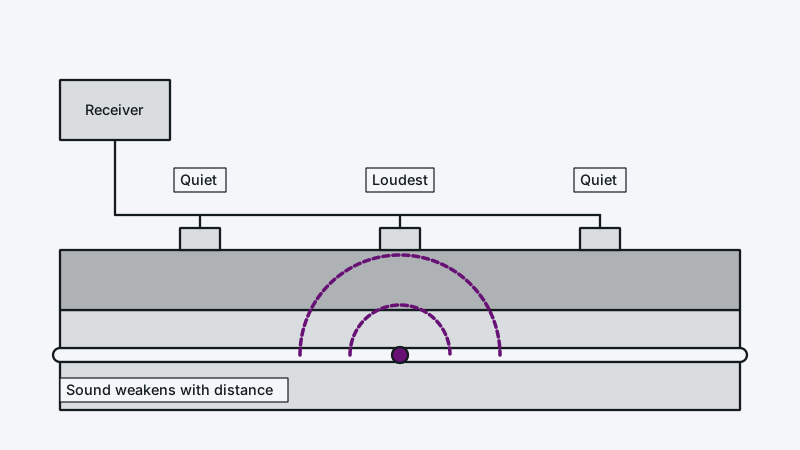
A careful search runs in this order:
- Meter check. With everything off, read the meter once. A moving dial or low-flow indicator tells you water is leaving the system somewhere.
- Isolate the lines. Hot and cold are tested apart. Closing valves at the water heater and on the street side shows whether the loss is within the house or on the run from the meter.
- Pressure test. A gauge on the isolated line shows if pressure holds. A needle that drifts down marks that line as the leaking one.
- Listen. Acoustic gear catches the noise of water forcing its way out of a pipe and up through concrete. What the technician listens for is explained on our acoustic leak detection page.
- Scan for heat. When a hot line leaks, a thermal camera can reveal a warm trail across the floor. The limits of the method are covered in infrared leak detection equipment.
- Mark and confirm. The floor gets marked, and the plumber will often double-check from another direction before suggesting a repair.
Stubborn cases may call for tracer gas or line-tracing tools. No house needs every method.
What should you do before the detection visit?
Turn off every fixture, locate the meter, and photograph the reading and the leak indicator. Give it fifteen minutes and shoot it again. Numbers that changed give you a measured leak to report, which speeds up the visit.
The EPA's Fix a Leak Week guidance describes the same test with a two-hour wait. It adds a check on a winter bill: a family of four using over 12,000 gallons in a cold month may have serious leaks.
Eliminate the easy suspects as well. A flapper that leaks quietly into the bowl can keep a meter turning on its own. Add a little dye to the tank and leave it ten minutes. If the bowl turns colored, fix the flapper before anything else. Other usual causes are in why a water bill runs high, and the leak detection by water meter page details the meter test.
Burbank Water and Power customers have an advanced metering system with usage data and leak alerts, so open your online account and look for water flowing at 3 a.m. The utility's customer service line is (818) 238-3700 on weekdays.
Clear a path as well. Shift furniture away from suspect areas and leave the meter, main shutoff and water heater easy to get to.
When should you call a plumber for a slab leak?
Phone once a meter test shows movement with everything off, or the first time you feel heat or hear water under the floor. A slab leak does not shrink. Water beneath a slab can undermine flooring, feed mold and add to the bill each day.
The meter and toilet tests are yours to do. Locating a leak under concrete is not a DIY job, and neither is the repair. Cutting a slab, repiping a line or relocating a water heater valve can require a permit, issued in Burbank by the city's building division and in the Los Angeles city neighborhoods of the Valley by LADBS, reachable at 3-1-1.
A local plumber we arrange will visit, go over your meter readings and give you the price in writing ahead of any work. Tell us what you have seen on the quote form.
How do you choose a slab leak repair company?
Judge by the written scope, not the first figure quoted. Ask who locates the leak, which method is used, whether the firm holds a California contractor license, and what state the floor is left in. Verify the license yourself through the state licensing board's online check page before you agree to anything.
A solid quote names the line, the spot marked on your floor, the repair method, any permit, and whether flooring and drywall repair are included or left to you. Treat a phone price given with no visit and no testing with suspicion.
Methods differ a lot in cost. Fixr's published guide lists spot repair and pipe lining at the lower end and rerouting lines through the attic at the top, putting a reroute somewhere between $4,000 and $15,000. Price ranges are broken down in slab leak repair cost, and the guide to slab leak repair or repipe explains when patching stops making sense.
Does homeowners insurance cover a slab leak?
That comes down to the policy. Many pay for sudden water damage to the home but not the pipe repair itself, and some cap or exclude the cost of reaching the leak. Others class a slow leak as wear and tear. Read the water damage section and speak to your insurer before hiring.
Fixr's guide says homeowners policies usually do not cover slab leaks themselves, though it varies by policy and region. Do not take a general rule as your answer. Ask your insurer three things: does the policy cover tear-out to reach the leak, does it cover damage to flooring and walls, and how soon must you report the loss.
Keep dated photos of the meter and the damage, hold on to the plumber's written finding, and do not throw out damaged materials before the adjuster inspects them. More detail sits in whether burst pipes are covered by insurance.
What happens after the leak is found?
With the spot marked, the plumber lays out options. A spot repair through a floor opening is typically cheapest. After that come tunneling beneath the slab from outside and lining the pipe from within. Running a new line through the walls or attic is the last resort.
Which one fits turns on the number of leaks, the pipe's condition and its route. One pinhole in a pipe that is healthy elsewhere suits a spot repair. Several leaks on one line, or leaks that keep reappearing elsewhere, usually mean the pipe has run its course, and a reroute or whole house repipe can end up cheaper than opening the floor again and again.
Fixr offers rough durations: trenchless work in about two hours, tunneling four to six, breaking the slab one to two days, and rerouting longest of all. They are national figures, so get your own schedule in writing.
Questions people ask
How long does slab leak detection take?
Expect the search to run several hours, shaped by the number of lines tested and the noise level in the house. One loud leak on an easy-to-reach line goes quicker. Multiple lines, thick concrete or a leak that only appears under pressure stretch it out. Request a time window when booking, and note that locating and repairing are separate jobs.
What should I ask before I hire someone for slab leak detection?
Ask which methods are used, if the price includes a written report marking the leak, and if the fee counts toward the repair should you hire them. Request their contractor license number and run it through the state's lookup. Find out what happens when no leak turns up, and whether they will say so plainly.
Do I need to be home for slab leak detection?
An adult should be present for the opening and the close. Access to the meter, shutoffs and the affected rooms is needed, and the plumber will explain the test results before pricing a repair. Noise matters too, since listening gear hears background sound, so stop the dishwasher, washer and sprinklers during the test.
Can a slab leak be fixed without tearing up my floors?
Sometimes. Pipe lining and certain epoxy methods work from access points rather than a big opening, and tunneling from outside avoids interior floors entirely. Whether they suit your house depends on pipe condition and where the line runs. Expect any method to leave some patching, and ask the plumber to say which finishes are included in the price.
This guide is one of many on plumber burbank.
References
Updated