Pick a tank when you want the lowest price and the simplest swap. Pick tankless when you want a supply that never empties, you are short on space, and your gas line, vent and budget can handle the larger job. In many Burbank homes the answer depends on the garage, closet or attic where the heater lives now. A local plumber we arrange can inspect it and price both. If you are weighing repair against replacement, begin with our water heater plumber page.
What is the difference between a tank and a tankless water heater?
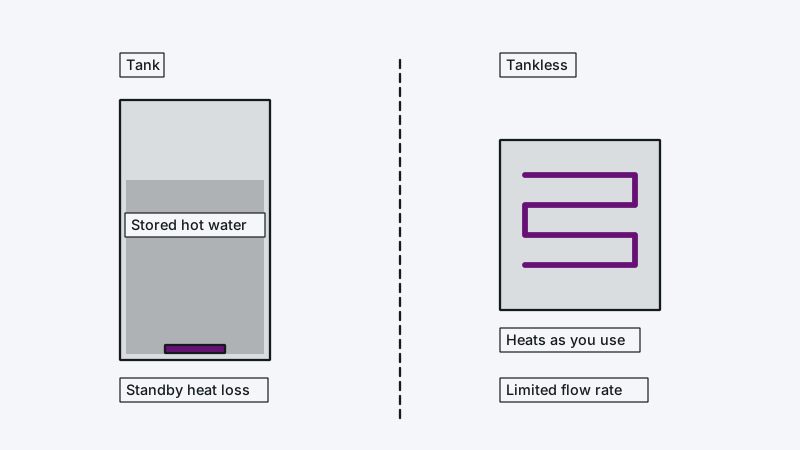
A tank heater keeps 30 to 75 gallons hot all day and refills when you use it. A tankless heater heats water only as it flows through, so there is no tank to run out. The Wikipedia overview of water heating explains the tradeoff: tanks lose heat through the walls while they stand ready, and tankless units avoid that loss but cost more to buy and install.
Flow is the catch with tankless. A unit delivers its rated gallons per minute for as long as you want, but only up to that rating. Run the shower, dishwasher and a second shower together and a small unit can go lukewarm. A tank does the opposite: strong flow until the hot water is used up, then a wait while it recovers.
Both designs come in gas and electric versions, and heat pump tanks use electricity far more efficiently than resistance elements, at a higher price. For a house on natural gas, the gas versions are the usual pair to compare.
Is a tankless water heater worth the extra cost in Burbank?
It depends on how you live. As a rough guide, tankless installs often cost $3,000 to $6,500 while a tank comes in at $1,500 to $3,500. The savings from avoiding standby loss are modest for a small household, and the Wikipedia article on water heating notes a long payback for some studies. The real gains are endless hot water, a longer service life and floor space.
If you have a large family, a soaker tub, or a guest house that sits empty most of the year, the answer shifts. A big family with back to back showers gains from tankless. A single person in a condo may never recover the extra cost. A vacation house that sits empty saves standby heat by using tankless.
Lifespan is the other argument. Tankless units commonly last 15 to 20 years with yearly descaling, against 8 to 12 for a tank, so some owners see the price spread over a longer period. In hard Valley water, skipped descaling can erase that advantage. See tankless water heater installation price for the line items behind the figure.
What does a gas tankless water heater need that a tank does not?
A gas tankless unit usually needs a larger gas line, a bigger vent and a power outlet, and sometimes a condensate drain. Many of them burn at a much higher rate than a tank, so a line sized for a 40,000 BTU tank may be too small. The Wikipedia article on tankless heating notes that retrofits may require larger gas lines, bigger wiring or a new vent.
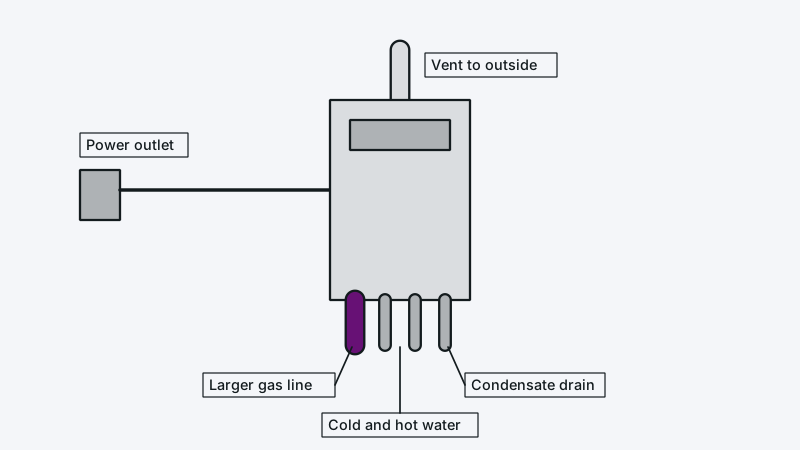
That is why a plumber wants to see your meter, the gas line and the old vent before pricing. In a postwar Valley ranch house, running a larger gas line across a slab house or up through the attic is where the cost grows. A garage on an outside wall is the easy case.
The gas piping, vent and permit are all regulated work, and the permit is normally pulled by a plumber holding a California contractor license. Our page on condensing tankless installation covers the vent and drain details. Rules from the South Coast air district about new gas heaters are also changing, so ask the plumber which units are currently allowed.
What about electric tankless versus an electric tank?
An electric tankless unit is compact and has no vent, but it can pull a very large amount of current at once. Many houses built in the 1950s and 1960s have a 100 amp panel, and a whole-house electric tankless may need a panel upgrade and heavy wire. An electric tank, on the other hand, needs a modest circuit and is cheap to swap.
Electric tankless makes the most sense for a small point-of-use need: a far bathroom, a casita or a bar sink. Electricity often costs more per unit of heat than natural gas, and the Wikipedia article on tankless heating makes that point about point-of-use units.
If you are choosing among electric options, the heat pump tank is the efficient route, and our electric water heater replacement cost page lists a range. A heat pump needs air space around it and drips condensate, so it does not suit every closet.
Does hard water change the answer?
Yes. Valley water is generally hard, and tankless heat exchangers are narrow, so scale builds up and cuts flow and efficiency. Manufacturers call for yearly descaling, which Wikipedia also notes. A tank collects sediment too, but it is more forgiving. A whole-house softener or scale reducer protects either type. Read your city utility's water quality report for the actual hardness.
Burbank Water and Power, Glendale Water and Power and LADWP each publish a yearly report for their own customers. Check yours before you buy a tankless unit, and plan for the descaling visit. Our page on water softener installation explains the options.
Ignoring this is the common reason a tankless install disappoints. A unit that was never descaled can fail early, and some warranties require proof of service.
How do the two compare for a Burbank house, side by side?
Side by side, a tank wins on price and simplicity, and tankless wins on supply, lifespan and footprint. The figures below are guides for the Burbank and San Fernando Valley area, so read them as a range and not a quote. What decides it is the list of changes your own house would need, which only a visit shows.
| Factor | Tank | Tankless |
|---|---|---|
| Typical installed cost, as a guide | $1,500 to $3,500 | $3,000 to $6,500 |
| Hot water supply | Runs out, then recovers | Continuous up to its flow rating |
| Typical life | 8 to 12 years | 15 to 20 years with descaling |
| Space | Floor space for a 40 to 50 gallon tank | Wall mount, small footprint |
| Gas line and vent changes | Rarely any on a straight swap | Often needed |
| Hard water care | Flush and anode check | Yearly descaling |
| Power outage | Gas tank can still make hot water | Needs power for controls |
Use the table as a starting point. Two quotes, one for each type, from a plumber who has seen the space is the only fair comparison. When you request a quote, say which type you are leaning toward and why.
Do not forget the permit, the earthquake bracing and the written quote. What a quote should list is explained in our water heater replacement cost guide, and the Lankershim Plumbing home page lists our other services.
Questions people ask
Is a tankless water heater better than a tank?
Neither is better for everyone. Tankless wins on endless hot water, space and service life. A tank wins on price, simple swaps and fewer building changes. The right pick comes from your gas line, vent path, household size and budget. A plumber who prices both for your house gives the fairest answer.
Will a tankless water heater lower my gas bill?
Probably a little, mostly by avoiding standby heat loss, but the saving is smaller than many ads suggest. Households that use a lot of hot water gain the least from efficiency alone, and small households gain a small amount. Do not count on the savings to repay the extra install cost quickly.
Can I use a tankless heater with no electricity?
Gas tankless units still need electricity for the fan, controls and ignition, so a power outage stops them. A gas tank heater with a standing pilot can still make hot water, though newer models also need power for controls. If outages matter to you, ask about a battery backup.
Why do some plumbers not recommend tankless water heaters?
The common reasons are cost, the gas line and vent changes, hard water scale and the maintenance needed. A tankless unit installed with no descaling plan can fail early. Plumbers who say yes to tankless usually want the line size, vent path and water quality checked first.
How long do tank and tankless water heaters last?
A tank commonly lasts 8 to 12 years, and a tankless unit often 15 to 20 years with yearly descaling. Hard water, heat and skipped maintenance shorten both. See our guide on how often to replace a water heater for the signs of a tank that is near the end.
References
Updated