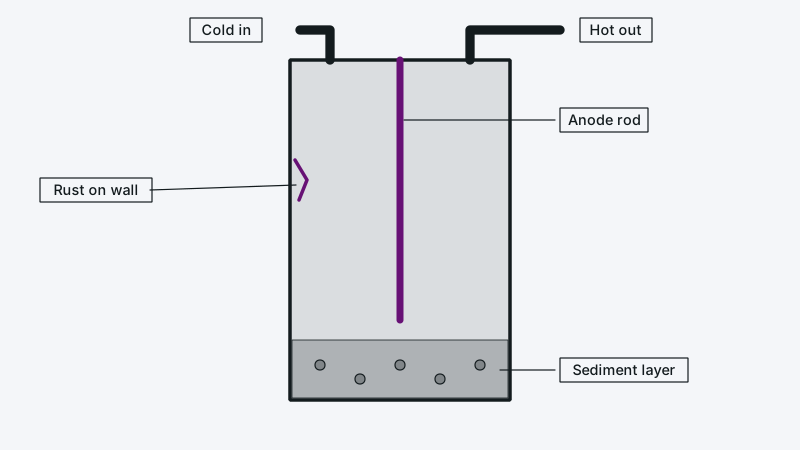
Expect a conventional tank heater to run roughly 8 to 12 years, and a tankless unit often 15 to 20 when it is descaled every year. Those are typical figures, not a promise, and heat, hard water and skipped maintenance pull them down. Replace sooner if the tank leaks, rusts or rumbles. To see how a plumber weighs repair against replacement, read water heater repair and replacement.
How long does a water heater last in Burbank?
A tank typically gives 8 to 12 years, with the lower end more common in the San Fernando Valley than in cooler, softer-water areas. Hard water drops scale in the tank and on elements, and hot summers keep a garage or attic heater working in high ambient heat. A tank that had an anode rod check or a flush now and then may reach the top of the range.
Warranty length is a rough clue, not a lifespan. ENERGY STAR sets a minimum of six years of warranty for qualifying gas storage and heat pump models. Many tanks carry longer coverage on the tank itself, but check what the paper actually says, since labor is often excluded.
Tankless heaters last longer because they have no standing tank to corrode, but the heat exchanger scales up in hard water. The Wikipedia article on tankless heating notes that descaling is essential. A unit that has been serviced yearly can run past 15 years, and one that never was may not.
Hard water varies by city. Burbank Water and Power, Glendale Water and Power and LADWP each publish an annual water quality report for their customers, which lists hardness.
What are the signs that a water heater needs replacing?
Water around the base, rust-colored hot water, rumbling or popping from sediment, a tank over ten years old that now needs repeated repair, and rising gas or electric bills are the common signs. Any leak from the tank body is final. Rust at the seams or the bottom of the jacket often comes before a leak.
Hot water that runs out faster than it used to is another hint. Sediment takes up tank volume, and a failed element or dip tube cuts the supply. A single repair is often worth it, and a second repair within a year on an old tank usually is not.
The age is on the data plate. The serial number often encodes the month and year of manufacture, usually as a letter for the month and two digits for the year, though each maker uses its own system. If you cannot decode it, ask the plumber or read the maker's guide.
Check around the tank at least twice a year. A pan with water in it, a damp floor or stained drywall below an upstairs heater is the early warning. For the first thing to do if it is wet, read how to repair a leaking water heater.
Do I really need to flush my water heater every year?
Flushing once a year is a common recommendation and good in hard water, but it is not required by law. Draining a few gallons from the drain valve clears sediment that cuts efficiency and makes noise. In the Valley, many plumbers suggest yearly. In softer water, every two or three years can do. The point is to do it regularly.
Most owners can do it with a garden hose. Cut the power, or put a gas heater on pilot, then shut the cold supply, point the hose at a drain or outdoors and open the valve. Let air in by opening a hot tap on an upper floor. Close the valve and refill the tank before the power returns, or an electric element will burn out.
A plumber doing a flush often checks the relief valve and the anode rod too, and charges roughly $100 to $250 as a guide. If the drain valve is plastic and brittle, ask before you turn it. Our page on drain valve replacement covers when that valve itself needs replacing.
Should I flush a 15 year old water heater?
Be careful. A tank that old and never flushed has a hard layer of sediment, and the drain valve can clog or leak once disturbed. Flushing may also reveal a weak spot that was plugged by scale. It is not a danger, but it is a gamble. If the heater is past 12 years, replace it on your schedule, before it fails on its own.
If you decide to flush anyway, have a replacement valve and a bucket ready, and do it on a day when you can live without hot water. Do not expect the flush to renew the heater. It cleans the tank, not the rusted steel.
A fifteen year old tank is worth replacing even if it still works. A planned swap is cheaper and calmer than a flood at midnight, and it can include an expansion tank, new connectors and earthquake straps. See the water heater replacement cost guide for what to budget.
Can I make a water heater last longer?
Yes, to a degree. Flush the tank yearly in hard water, check the anode rod every few years, test the relief valve gently, keep the thermostat near 120 degrees Fahrenheit and keep the area around the heater clear. A water softener or scale reducer also helps. These steps stretch life, but they cannot undo a worn-out tank.
Lowering the thermostat also lowers scald risk and scale. A new anode rod, swapped in for a corroded one, can buy extra years for an otherwise sound tank. Hard water can eat through the rod within a few years, so a plumber might recommend inspecting it sooner. An expansion tank on a closed system reduces pressure stress on the tank.
Our page on water softener installation covers softeners for the Valley's hard water. If you are weighing a tankless upgrade at the end of a tank's life, read tank versus tankless.
What does replacement involve, and who handles the permit?
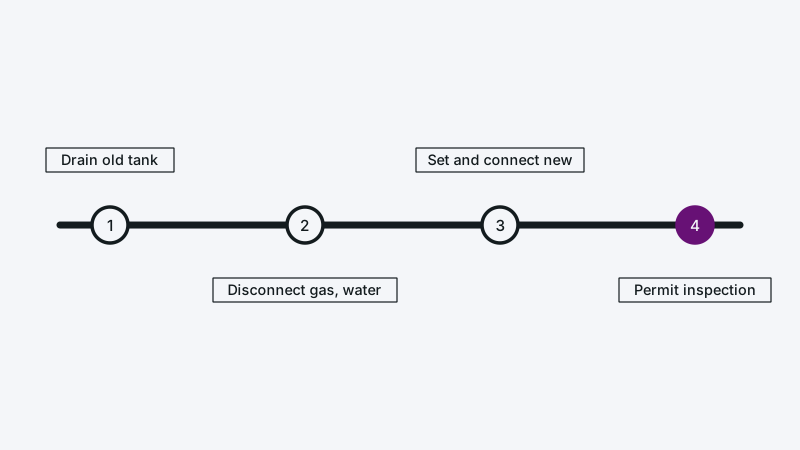
A replacement normally needs a plumbing permit and an inspection. Burbank handles it through its building division, and the Los Angeles city neighborhoods of the Valley through LADBS. Under California law, a water heater must be strapped to resist earthquakes. A plumber with a current California contractor license usually handles the permit along with the gas and vent work.
Send a quote request and a local plumber will be lined up to inspect the heater and put the price on paper before work begins. You will find the other services we set up around Burbank and the Valley on the Lankershim Plumbing home page, listed by topic.
Questions people ask
What is the average lifespan of a water heater?
Roughly 8 to 12 years for a tank and 15 to 20 for a tankless model, based on the typical manufacturer and energy agency ranges. Hard water, high ambient heat and no maintenance shorten both. The signs matter more than the age: a leak, rust or repeated repairs mean replace.
What is the average lifespan of a gas hot water heater?
A gas tank typically gives 8 to 12 years, much like electric, though burner scale and sediment on the tank bottom can bring it in sooner. Flushing and an anode rod check help. A tankless gas unit often lasts 15 to 20 years if it is descaled each year and vented properly.
Is it worth repairing a 10 year old water heater?
For a small fix such as a thermostat, element or thermocouple, often yes. For a leak from the tank, no. Once a repair would cost more than 50 percent of a new heater, replacing usually wins, because an aging tank tends to need another repair soon.
Can a water heater last 20 years?
A few do, typically in soft water with regular flushing and a fresh anode rod, yet it is a poor bet. Past 12 years a tank is on borrowed time, and failure often comes without warning. A planned replacement avoids water damage.
How can I tell how old my water heater is?
Find the data plate on the tank's flank and read it. The serial number usually encodes the manufacture date, often as a month letter and a two digit year, though each maker differs. If it is unclear, give the plate details to the manufacturer or the plumber, who can decode it.
References
Updated