Lukewarm, scalding or missing hot water from an electric tank puts the thermostat high on the suspect list, alongside the heating elements. Swapping a thermostat is a minor repair, often done in one visit by a local plumber, since the part costs little and sits behind a panel on the tank. If a new unit is also on your mind, begin with water heater repair in Burbank and return here for thermostat specifics.
How do I know the thermostat is the problem and not the heating element?
Certainty needs a meter. A bad thermostat tends to produce water that is far too hot, stuck at lukewarm, or swinging between the two. A burned-out element more often gives a few minutes of hot water and then cold. Testing both with the power off is the only way to tell them apart.
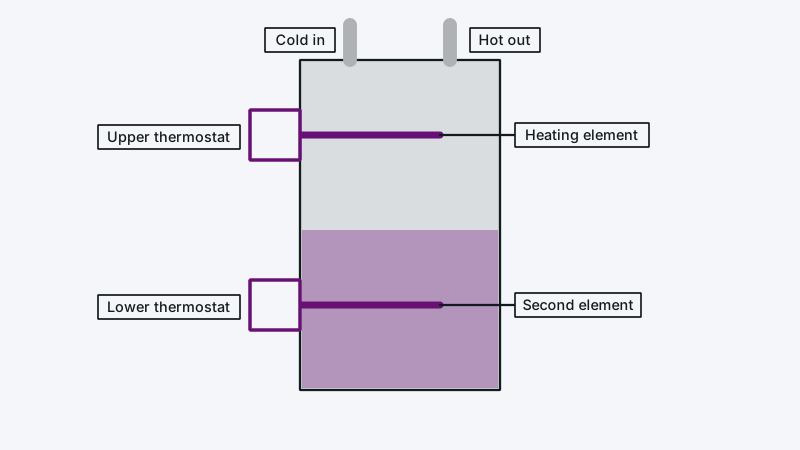
Residential electric tanks generally carry two thermostats, one behind each access panel, with an element next to each. Power reaches the upper thermostat first and passes down to the lower one, which accounts for some strange symptoms. A failed upper thermostat or safety cutoff can leave the entire tank cold. A failure on the lower side alone gives a brief run of hot water drawn from the top, then nothing.
Patterns Valley homeowners describe most often:
- Scalding water at the tap with a dripping relief valve. A thermostat may be stuck closed, which is a safety problem. Switch the breaker off and call.
- Water that is warm and never hot. This is often the lower thermostat or lower element.
- No hot water whatsoever, with the upper thermostat's red reset button sprung out. That is the high-limit cutoff, and it tripped for a reason.
- Ten minutes of hot water and then cold. Usually the lower element or lower thermostat.
Is it safe to check or replace an electric water heater thermostat myself?
A look is safe once the power is off and you have verified that it is. Replacing the part is where we draw the line. These tanks run on a 240 volt circuit, and terminals behind the panel can stay live if you flip the wrong breaker or a double breaker is only half off. Without a voltage tester and the know-how to use it, hand the job to a local plumber.
Steps that are safe for you to take, in sequence:
- Switch off the heater's dedicated double breaker at your panel.
- Take off the access panel only if you plan to look inside, and prove the terminals are dead with a voltage tester before touching anything.
- Check for scorched wires, melted insulation or water staining. Any one of these means stop and call.
- Press the red reset button found on the upper thermostat, once only. A heater that works afterward still has a problem, since that button trips for a reason.
Do not power an electric tank that is empty, because dry elements burn out within minutes. If the tank was drained for any reason, fill it completely and run a hot tap until water flows before the breaker goes back on.
What does thermostat replacement involve, step by step?
The plumber cuts the power, tests the circuit, exchanges the failed thermostat for a matching one, tests the elements along the way and checks the water temperature once it heats. One visit is normal, since thermostats for common tanks are stocked parts.
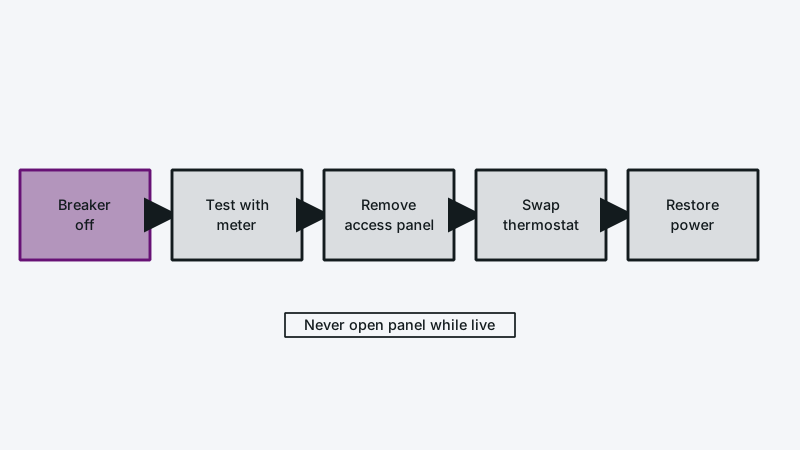
The visit generally goes in this order:
- The breaker goes off, then the terminals get a meter test.
- Panels and insulation come off. Elements are tested for resistance, because a failed element and a failed thermostat often appear together.
- The old thermostat comes out and the new one clips flat against the tank wall to read the tank surface, with wires returning exactly as labelled.
- Panels go back on, power is restored, and the temperature is set and verified at a tap after the tank reheats.
Contact with the tank wall matters. A thermostat that does not sit flat reads wrongly, which is why some DIY swaps leave the original symptom in place.
What temperature should an electric water heater thermostat be set to?
Tanks mostly leave the factory set near 120 degrees Fahrenheit, and the US Department of Energy has long pointed to that as a sensible household setting. It handles dishes and showers while holding scald risk down, particularly around small children or older adults. Higher settings add to your bill and speed up scale in the tank.
Valley summers shift the picture. Burbank garages and utility closets get very warm in July and August, and a tank in a hot space sheds less heat than one in a cold shed. You might lower the dial a notch without noticing at the tap.
A dial with no markings is no obstacle: a plumber can measure the real water temperature with a thermometer at the nearest tap and adjust from that reading.
When does a thermostat replacement stop making sense?
On a tank that is old, leaking or heavily rusted, a new thermostat is money spent on a unit about to fail for some other reason. We assess the whole tank before recommending the cheap part. Hard water coats the lower element and the tank floor with scale, which shortens the life of everything inside.
Signs that favor a new tank over a repair:
- Water collecting at the foot of the tank, rather than at a fitting you can tighten.
- Rust-coloured hot water at the tap while cold water runs clear.
- Rumbling or popping while the tank heats, which suggests heavy sediment.
- A tank so old that the repair money would be better put toward a new unit. Age and what to weigh are covered in how often a water heater needs replacing.
Moving to a new unit? Electric versus tankless water heaters lays out the tradeoffs. Tankless models demand a much larger electrical supply than a tank, and in an older ranch house that can mean a panel upgrade. That conversation is far bigger than a thermostat.
Do I need a permit to replace a water heater thermostat?
Replacing a part inside the heater with an equivalent one generally needs no permit, since the appliance itself stays. A full replacement is different and normally does need one. Burbank homes answer to the city's Building Division, and homes in Los Angeles neighborhoods of the Valley answer to LADBS. Check with whichever covers your address before any bigger work.
New circuits, wiring changes and panel upgrades are permit items of their own. A plain thermostat swap involves none of them.
When should I call a plumber instead of waiting?
Make a same-day call if the water scalds, the relief valve discharges, you smell burning or spot scorch marks, or the breaker keeps tripping. Such signs mean a safety fault rather than a worn part. Switch the breaker off and keep people away from the hot water until it has been checked.
Send a visit request through our quote page, and the local plumber will state a price in writing ahead of any work. The how it works page describes the steps. The Lankershim Plumbing home page lists other problems we cover, such as no hot water from an electric heater.
Questions people ask
How many hours does a thermostat swap on an electric heater take?
A single thermostat typically means one to two hours at the house, a little more if both are replaced or the elements are tested and swapped too. The tank stays full for a thermostat job, so no refill step is needed. Reheating afterward takes a while, an hour or longer for many tanks, depending on size.
Which questions should I put to a contractor about thermostat work?
Get the price on paper before work starts, and learn whether the quote includes testing the elements and whether the part directly matches your tank model. Look the contractor's license number up on the state licensing board's website. Also find out how long the visit will take and whether you must be home.
Must I be home while the thermostat is replaced?
Be home when the work begins and when it ends, or have someone there for you. The plumber must reach the heater, often in a garage or closet, and you should confirm that hot water has returned at the temperature you like. A heater in a locked space needs access arranged ahead of time.
Can a bad thermostat make my electric bill go up?
Yes. A thermostat stuck on keeps the elements running and heats water far beyond the setting, so scalding water and a bigger bill can arrive together. One that fails off gives cold water at no extra cost. Very hot water with a dripping relief valve is your cue to switch the breaker off and call.
Is the reset button the same as the thermostat?
No. The red reset button is a high-limit safety cutoff built into the upper thermostat unit, and it trips when water gets dangerously hot. Pressing it can bring power back, but it keeps tripping until the cause of the overheating, often a faulty thermostat or element, is fixed. Never tape it down or bypass it.
References
Updated