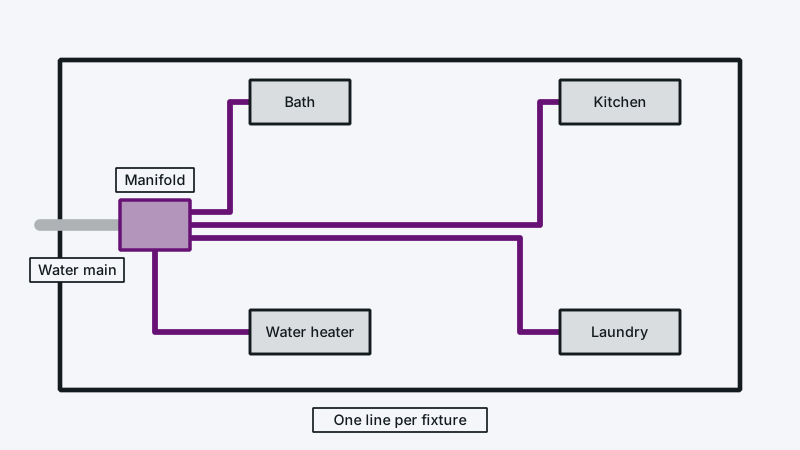
A whole house repipe means replacing the water supply lines that run from your meter to every faucet, toilet, appliance and water heater. In Burbank and the rest of the San Fernando Valley it is most often done on postwar homes still running galvanized steel, or on older copper that has started to leak. A local plumber we send out will inspect your house and prepare a written quote. Begin on the quote page, or keep reading to see how the job goes.
How hard is it to repipe a house?
The job is large, yet routine for a plumber who does it regularly. The crew opens walls or routes lines across the attic or crawl space, hooks up every fixture, tests the new system and has the work inspected. For a homeowner it is not a weekend project. In California the job requires a permit and a contractor holding the correct license.
The hard part is access. A single-story ranch house with an attic and a raised foundation is the easy case. A slab-on-grade home, a two-story house with stacked bathrooms or a hillside lot costs more and takes longer, because lines have to go through finished walls or around concrete. The plumber's walk-through shows which case you have.
Can you replumb a house without removing walls?
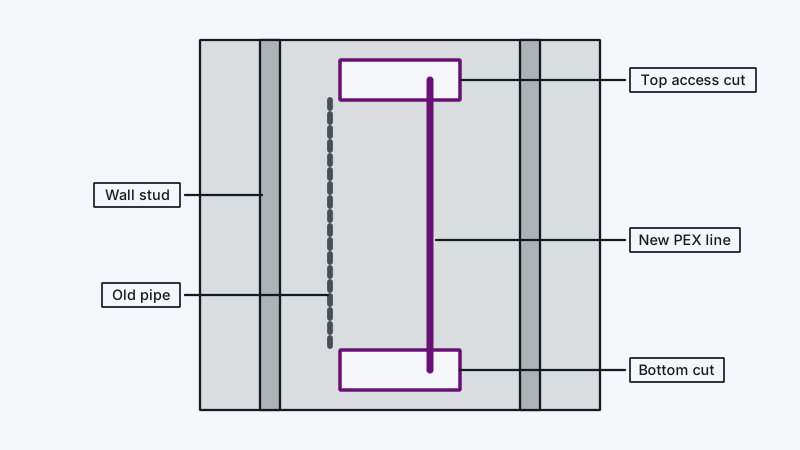
Often you can avoid opening most walls, but not all of them. Flexible PEX tubing can be fished through wall cavities, attics and crawl spaces, so the plumber cuts small access holes at fixtures and patches them afterward. Rigid copper needs more room to work. Some drywall repair is normal on almost any repipe, and the quote ought to name who does it.
Where the house sits on a slab, the plumber may leave the old lines in the concrete and run new ones overhead through the attic. That avoids breaking the slab, at the cost of lines in the ceiling and more patching. If the only trouble is a leak below the floor, start with our page on slab leak repair versus repiping first, because a spot repair may be enough.
Does repiping a house add value?
Mostly it defends value rather than raising it. A buyer's inspector who finds galvanized supply lines in a Burbank ranch house may ask for a credit or a repipe before closing, so new piping takes a negotiating point off the table. It rarely lifts the sale price the way a new kitchen does. Keep the permit sign-off and the plumber's paperwork with your house records.
Think about what leaving the pipes costs you. Rust-clogged galvanized lines choke water pressure, stain fixtures and eventually leak inside walls, and a wall leak can mean drywall, flooring and mold work that costs more than the repipe. The decision usually turns on how much damage the old pipe is already doing, not on resale.
What devalues a house the most?
Problems a buyer can't see and can't price do the most harm to an offer. Foundation movement, a failed roof, unpermitted additions and old plumbing that has started to leak all push buyers toward lower bids or the exit. Of those, aging supply pipes are one of the cheaper items to fix, which is why a documented repipe helps when a house is listed.
Water damage history is its own category. An earlier leak that left mold or rot behind a wall can show up in an inspection report and follow the house. If you have had repeated pinhole leaks, replacing the piping once usually costs less than patching each leak as it appears.
How much is a full house repipe?
One national guide gives about $7,500 as the average repipe, inside a broad range of roughly $1,500 to $15,000. Material matters: PEX runs about $0.40 to $2 per linear foot, CPVC about $0.50 to $1 and copper about $2 to $8. Permits and inspection come on top. Southern California quotes can land above national figures, so read these numbers as a rough starting figure.
What moves the total is the size of the house, the number of bathrooms and fixtures, how hard the pipes are to reach, how much drywall has to be repaired, and whether the plumber also replaces the line from the meter. Our repipe cost page breaks those pieces down, and the PEX repipe cost page covers that one material.
How long does it take to repipe a house?
Budget a few days for an average house, and the water goes off for a portion of every day. The written quote should give a schedule. Small homes with open attic access go faster, while two-story homes, slabs and houses with many fixtures take longer. The inspection also sets the calendar, because plumbing must be inspected before walls are closed.
Most people can remain home while the work goes on, though water will be off at times. Ask the plumber when the shutoffs will happen, and keep drinking water on hand. The day-by-day sequence appears on our galvanized pipe replacement page.
Which pipe material should you choose?
Many repipes now use PEX or copper. PEX costs less, goes in faster and bends enough to snake through walls. Copper has decades of proven use and tolerates heat and sun, which counts in an exposed attic. California approved PEX for its plumbing code around 2009, so both are allowed. Our PEX versus copper comparison lays out the trade-offs.
If you pick PEX, there are also types to sort out, covered in PEX A versus B. Which choice fits depends on your house and your water. Ask for the material, the fitting type and the pipe sizes in writing, so you can set quotes side by side.
How do you know it is time to repipe?
The signs are rust-colored or metallic-tasting water, falling pressure at several fixtures, repeat leaks at different spots and visible corrosion at joints. Galvanized iron was common in American potable water systems from the late 1800s until about 1960, with a service life of roughly 30 to 50 years. A Valley house built in the 1940s or 1950s may be well past that.
LADWP puts the average at about 20 years before rust shows, and up to 40 for well-made galvanized pipe. Burbank housing is old: more than 62 percent of homes were built before 1970. Our page on why people repipe a house walks through the signs one by one.
What about cast iron and drain pipes?
A repipe usually means the supply side, the pressurized pipes that bring water in. Drain, waste and vent lines are separate. Many Valley tract homes dating to the 1940s through 1960s have cast iron or clay drains that can crack, scale over and clog with roots, and replacing those is its own job. See cast iron pipe replacement for that work.
Some owners combine the two jobs to open the walls once. That can save labor, but only if both systems really need work. A camera look inside the drains tells you whether they do.
Who is allowed to do a repipe in California?
State law sets a contractor license threshold of $1,000 in combined labor and materials, and also applies whenever a building permit is needed. A repipe meets both tests. The C-36 classification covers plumbing. Before signing, check any contractor's license using the CSLB's online lookup.
Permits come from your city: the Burbank Building Division, Glendale Building and Safety, or LADBS for LA city neighborhoods such as Van Nuys and Sherman Oaks. Concealed work is inspected in stages. The plumber typically handles the permit. How a quote comes together is on the how this works page.
What does Valley water do to old pipes?
Moderately hard water leaves scale. For 2022 LADWP reported San Fernando Valley hardness averaging near 8.6 grains per gallon, from 5.4 and 16.1. Scale narrows old steel pipe from the inside. Burbank Water and Power and Glendale Water and Power publish their own reports, so read the one for your address.
When new copper meets old steel, a dielectric coupling keeps the steel from rusting faster. If only part of the system is replaced, ask how the plumber will handle that joint. We arrange work in Glendale, North Hollywood and the rest of the neighborhoods we cover, starting from the Lankershim Plumbing home page.
Questions people ask
Which three kinds of plumbing does a house have?
A house has three systems: potable water supply, drain-waste-vent, and gas piping. Supply pipes deliver pressurized clean water. Drain, waste and vent pipes take used water away and admit air so drains run freely. Gas lines feed the water heater, stove and furnace. A repipe replaces the first type only. Gas piping is a separate permitted job.
Is there a 135 rule in plumbing?
No rule under that name turned up in the California Plumbing Code, and we won't guess at its meaning. If a contractor or inspector cites it, ask which code section they mean and what it applies to. For anything under permit, the Burbank Building Division or LADBS can tell you which code sections an inspection will check.
May a homeowner replace a sewer line alone?
California has owner-builder rules, but a sewer line is buried work that needs a permit, an inspection before backfill and often a street or sidewalk permit. A mistake can flood a house or foul the soil. We suggest hiring a plumber with the proper license. Ask your building department about its owner rules before you decide anything.
Is a permit required to replace a sewer line?
Expect to need one. CSLB says permit rules come from the California Building Standards Code, which covers altering or repairing a building, and your local building department enforces them. Burbank, Glendale and LADBS each run their own. Normally the plumber gets the permit and books the inspection before backfill.
What is the least expensive sewer line replacement?
The answer turns on pipe length, depth and what lies above it. Trenchless options like pipe bursting and cured-in-place lining skip the full trench, which can save landscaping and driveway repair, but they are not always cheaper and do not suit every pipe. A camera inspection shows which methods are possible. Get quotes that name the method.
In this section
- Cast iron pipe replacement
Cast iron drain pipe replacement for Burbank and Valley homes: signs of failure, replacement and lining options, permits, and what drives…
- PEX versus copper
PEX vs copper for a Burbank repipe: cost, lifespan, flow, freezing and water chemistry compared, plus what to ask for in a written…
- Costs
How much to budget to repipe a house in Burbank: price ranges as a guide, what pushes the total up and the questions to ask before you…
- Galvanized pipe replacement
Galvanized pipe replacement for Burbank homes: the signs it is time, how long a repipe takes, whether you need a permit, and what a…
- PEX repipe cost
What a PEX repipe costs as a guide, how it compares with copper, and what to put in the quote for a Burbank house, a two-bath home or a…
- How a repipe is done
How a house is repiped step by step, including slab foundations and PEX layouts, how often it is needed, and where California law says a…
- PEX A versus B
PEX A and PEX B both meet the same standard.
- Why repipe
Why people repipe a house in Burbank: rusty water, low pressure, repeat pinhole leaks and aging galvanized or copper pipe, and how to tell…
References
- Cost to repipe a house, national figures
- California Contractors State License Board, what kind of contractor do I need
- California Contractors State License Board, building permit requirements
- California Contractors State License Board, C-36 plumbing classification
- Plumbing, materials and service life (Wikipedia)
- LADWP water quality FAQs
- Burbank, California housing (Wikipedia)
- City of Los Angeles Department of Building and Safety
Updated