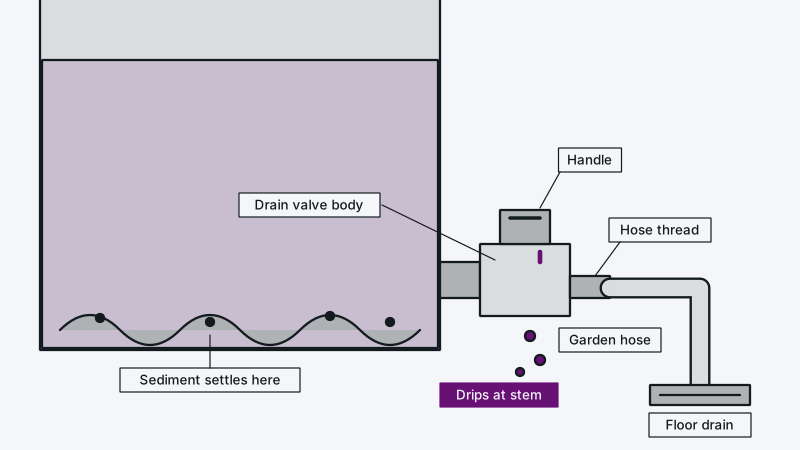
Every tank water heater has a drain valve near the floor, a small spigot with a hose thread that lets you empty the tank for flushing or replacement. It sits idle for years, then drips, will not open, or breaks when someone finally tries it. If the heater itself is healthy, a new valve is a short plumbing job. For the bigger picture, our hub on water heater repair in Burbank covers the rest.
Why is my water heater drain valve leaking?
The valve is probably worn, corroded, clogged with sediment at the seat, or made of plastic that has cracked from heat and age. A slow drip from the spout means the valve is not sealing. A weep around the threads where it screws into the tank means the connection has failed, and that can be more serious.
The spot where water shows up answers most questions:
- Drip from the spout, tank otherwise dry. Sediment or a worn washer is holding the valve open. Sometimes closing it firmly, or opening and closing it once, clears the grit. A hose cap screwed onto the spout often stops a slow drip as a stopgap.
- Wet or rusty around the threads at the tank. The valve may have loosened, or the tank wall around the fitting is corroding. Tank corrosion is not repairable.
- Cracked or soft plastic body. Common on budget tanks. Heat and years make the plastic brittle.
- Water at the base but the valve is dry. The water may come from higher up, such as a fitting, the relief valve line, or the tank itself. See water heater leak repair.
If the tank itself is the source of the leak, replacing the drain valve will not help, and a failing tank is a replacement question rather than a repair.
Can I replace a water heater drain valve myself?
You can if the tank is in good shape, you shut off the energy and water first, you can drain the tank fully, and you are ready for the valve to fight back. Many homeowners find the job harder than the part suggests, and that gap is the reason people hire a plumber for it.
The risks are real. Old valves seize, and forcing one can crack the plastic or tear the threaded nipple in the tank wall, turning a ten dollar part into a dead tank. Water in the tank is hot enough to scald for hours after the heater is turned off. Also, a tank with a lot of sediment may drain slowly or clog the valve opening halfway through.
Before any of it:
- Set the gas control to off or pilot, or switch the electric heater's breaker off. Never drain an electric tank with the power on.
- Shut the cold supply valve on top of the tank.
- Crack open any hot tap indoors so air can enter the tank.
- Attach a hose and run it outdoors or to a floor drain. Water that has sat in a tank can carry scale and rust.
- Let the water cool down first. A tank can stay dangerously hot well after the burner shuts off.
Stop here and phone a plumber when the valve refuses to turn or the tank has gone years without a flush.
How does a plumber replace the drain valve?
A plumber shuts off gas or power and the supply, drains the tank, unscrews the old valve, fits a new one with thread sealant, and refills the tank. A brass valve with a full-size opening is usually the upgrade over plastic. The job takes an hour or two, mostly in draining and refilling.
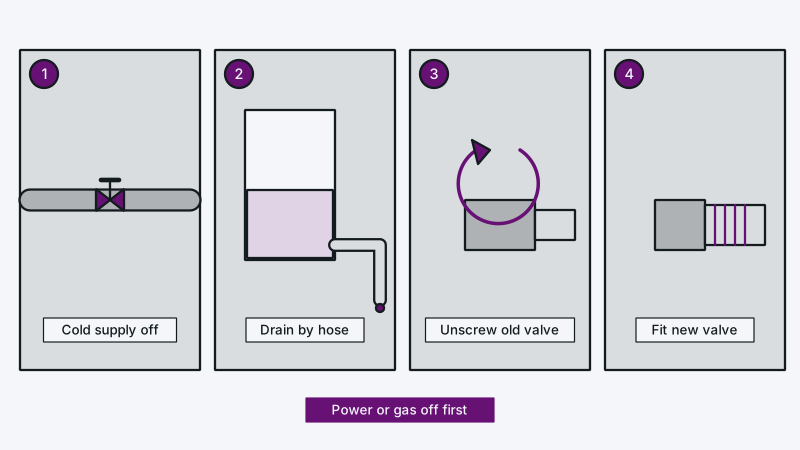
Typical sequence:
- Gas or power off, supply closed, hot tap open.
- Tank drained through a hose to a safe spot. Scale and sediment come out with it, and this is a good time to flush.
- Old valve removed. Plumbers check the threads and the tank wall for corrosion at this point.
- New brass valve with a three-quarter inch hose connection installed with pipe thread sealant, snug but not forced.
- Tank refilled with the hot tap left open until it flows smoothly with no air spitting, then the burner or breaker turned back on and the connection checked for drips.
If the old valve is seized, a plumber may decide the tank is not worth the risk of forcing it, and quote a replacement instead. Ask what the pricing looks like both ways.
Should I flush the tank while the valve is being replaced?
Yes, it is the best time. The tank is empty already, and sediment sitting on the floor of the tank is what usually clogs drain valves in the first place. Flushing with a few rounds of cold fill and drain clears loose scale, which can make the heater quieter and more efficient.
Hard water is a fact of life across much of the San Fernando Valley, and Burbank, Glendale, LADWP and Las Virgenes each report their own hardness numbers in the annual water quality report for your area. Harder water means scale piles up faster on the tank floor and around the lower element or burner. A tank nobody has ever flushed can hold a thick layer. If the sediment is heavy, flushing may do little, and it can signal that the tank is close to the end of its life.
Our guide on how often a water heater needs replacing helps judge that, and do-it-yourself water heater repairs shows what homeowners can safely do.
When is a stuck drain valve a sign the water heater needs replacing?
When the tank is old, rusted at the base, or the valve fitting is corroding into the tank wall, the valve is a symptom, not the cause. Trying to force a seized valve on an old tank can crack the fitting and release the tank contents. If a plumber advises against touching it, that is often why.
Signs to replace the tank instead:
- The tank is at or beyond the typical lifespan, and is rusting at the bottom.
- Rust-colored water at hot taps only.
- The valve fitting has white or green crusting, a sign of slow leakage.
- The tank makes rumbling or popping sounds from sediment.
In that case a new water heater installation costs more than a valve, but you avoid pouring money into a failing tank. See what it costs to replace a water heater and gas water heater replacement cost. For tankless water heaters, the equivalent maintenance is a descale flush through service valves, a different process.
How do I arrange a drain valve replacement?
Give the make and age of the tank, and say whether the leak is at the spout or the threads. Use the quote page to book, and you get the price on paper before work begins. How this works lays out the steps, and the Lankershim Plumbing front page lists our other jobs.
Questions people ask
How long does a drain valve replacement take?
Plan on one to two hours, most of it spent emptying and refilling the tank. Heavy sediment, a seized valve or a fitting eaten by corrosion can stretch that. If the plumber must also flush the tank or replace the relief valve, allow extra time. You have hot water again once the tank has refilled and reheated.
What should I ask a plumber about drain valve replacement?
Ask which valve goes in, brass or plastic, and whether the price covers draining, flushing and refilling. Ask what happens if the fitting at the tank is corroded and the valve cannot be removed safely. Look the contractor up on the state licensing board's website and confirm a California license is on file.
Does someone need to be home for a drain valve swap?
Yes, at the beginning and again at the end. The heater could be in a locked garage or closet, and the water in the house will be shut off for a while. Before the plumber leaves, confirm hot water has returned and the new valve is dry.
Is it normal for a drain valve to drip a little?
A drip means the valve is not sealing, so it is worth fixing, though it is rarely urgent. Slow drips can often be stopped by tightening the valve closed and fitting a hose cap. If the drip grows, or water pools, replace the valve. Always check that the water is coming from the valve and not the tank.
Can I use a brass valve to replace a plastic one?
Yes, and most plumbers prefer to. Brass valves handle heat better, last longer and have a larger opening, which helps when flushing sediment. The valve must match the tank threads, which are usually three-quarter inch. A plumber will fit the right one and seal it correctly, so it does not weep at the threads.
References
Updated