A leaking water heater needs three quick moves: close its cold supply, kill the power or gas, and get a plumber out the same day. When the drip comes from a fitting or valve, a repair often does it. When it comes from the tank, the tank is finished and a new heater is the answer. This page belongs to the water heater repair guide and helps you work out which of the two you are dealing with.
Where is my water heater leaking from?
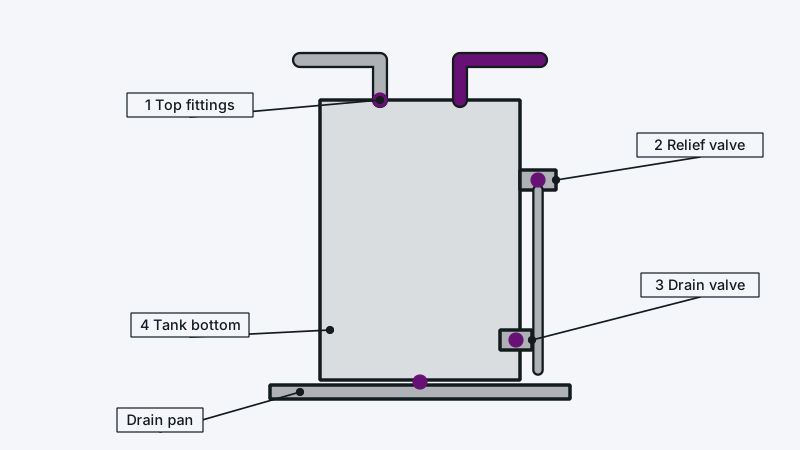
Look at where the water collects. Drips from the pipes on top, from the relief valve, or from the drain valve near the floor usually point to a part you can swap. Water pooling under the tank, or seeping from the seam of the outer jacket, usually means the steel tank has rusted through, and no repair will hold.
Check these spots with a dry paper towel, working from the top down.
- Top fittings. The hot outlet and cold inlet connections. A weeping joint or a worn flex connector is the cheapest leak to fix.
- The relief valve and its pipe. A drip at this spot may be a worn valve, or a sign that pressure or heat inside the tank is running too high. Treat it seriously, and read our page on pressure relief valve replacement.
- The drain valve. A plastic spigot at the bottom often drips after a flush. See drain valve replacement.
- Under the tank. A steady drip from the bottom, or a puddle that returns after you dry it, is the sign of tank failure.
- Gas models only. Moisture on the floor of the burner chamber can be condensation or a leaking tank. Do not poke around the burner.
Tank-style heaters are usually described as lasting about 8 to 12 years, and hard water can take two or more years off that. Check the serial number on the upper part of the jacket. The letter is the month (A is January) and the next two digits are the year.
What do I do right now to stop the water?
Shut the cold water valve on the pipe above the heater, set the thermostat to its lowest point, and cut the power. On a gas unit, turn the gas control knob to off. On an electric unit, flip the breaker. After that, open any hot faucet in the home so the tank cannot build pressure, and mop up what you can.
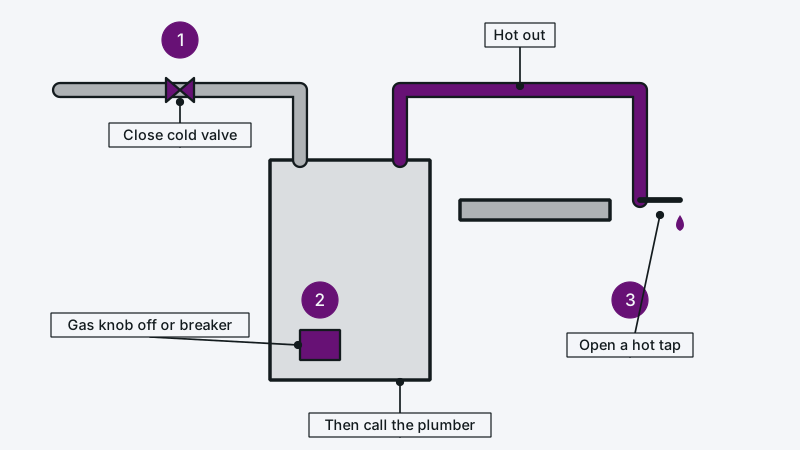
Order matters, so follow it.
- Water first. The cold shutoff is a gate or ball valve on the inlet. If it will not turn, use the main shutoff for the house.
- Then power or gas. Leave an electric element powered in a draining tank and it can burn out. A gas burner can keep firing into a tank with no water.
- Keep the room dry. Move boxes off the floor. Water heaters in Valley garages and hall closets often share a wall with finished rooms.
- Stay away from the electrical panel if the floor is wet. Never touch it with wet hands or while standing in water. Call the utility or an electrician.
Any whiff of gas means you exit the building and phone SoCalGas (1-800-427-2200) once you are outside. SoCalGas also advises dialing 911 when there is danger or the line will not connect. Leave lights exactly as they are on the way out.
If the leak is large, or the heater sits in an attic, a closet above a finished floor, or a hillside home with a raised subfloor, close the valve and wait for the plumber rather than draining it yourself.
Is it worth repairing a leaking water heater?
Repair makes sense when the leak is at a connector, a valve or the relief valve and the tank is dry underneath and under ten years old. Choose a new heater if the tank is what leaks, since rust has already worn through the steel. Have a plumber inspect it before you decide, because a fitting leak and a tank leak look similar.
Use this as a rough guide.
| What you find | Usual answer |
|---|---|
| Wet connector or flex line on top | Repair, small part |
| Dripping relief valve | Replace the valve, check pressure |
| Dripping drain valve | Replace the valve |
| Water at the base, tank seam wet | Replace the heater |
| Rust streaks, and the heater is past 10 years | Replace the heater |
A published guide puts a relief valve job at about $200 to $300 with a pro, and the part alone at about $20. Swapping a whole gas tank heater costs far more, with figures broken out in our water heater replacement cost breakdown. If the heater is old, a $250 repair on a failing tank is money you may lose within a year or two. Our page on how often to replace a water heater explains the timing.
What does a plumber do for a leaking water heater?
A plumber finds the source, shuts things off safely, and either replaces the failed part or removes the heater and installs a new one. For a replacement they drain the tank, disconnect the gas or electric supply, set the new unit, connect it, test the gas joints and relief valve, and check the strapping.
State law says a water heater must be braced, anchored or strapped to resist quake movement, so strapping the new tank is part of the install. A replacement normally needs a permit, which the plumber should take care of. Find out who files it, and read our write-up covering a water heater permit in Burbank.
Why a plumber and not a handyman for the connection work: gas piping and the earthquake strapping both have code requirements, and a bad connection can leak gas. Plumbing work over a small dollar limit also falls under California's contractor licensing rules, and the state licensing board's lookup at cslb.ca.gov lets you verify a plumber before you sign anything.
When should I call a plumber and not wait?
Phone the same day when the leak is steady, the tank itself is leaking, the heater sits in an attic or over living space, or you are unable to stop the flow. A slow fitting drip can hold until the next business day once the valve is closed. A gas smell or scorching around the burner is an emergency, and you leave the house first.
Urgent cases are covered under emergency water heater repair. If nothing is urgent, use the quote form and we will line up a local plumber for your address. The price comes in writing ahead of any work, and the plumber confirms the permit and strapping.
A fitting leak is also a chance to look at the bigger picture. Ask whether the heater is close to wearing out, whether the relief pipe runs to a safe spot, and whether tankless water heaters would suit your gas line. A tankless swap often needs a larger gas line and new venting, which is why it costs more up front. Everything else we handle around Burbank and the Valley appears on the Lankershim Plumbing site home, under every service heading.
Questions people ask
How long is the plumber on site for a heater leak?
Fixing a fitting, valve or connector tends to run about an hour or two at the house. A full heater replacement is commonly half a day, since the old tank must be drained, carted off, and replaced with a new one that is hooked up, strapped and tested. Cramped access, venting work and gas line changes can stretch the visit.
What do I check before hiring someone for this leak?
Find out who will do the work and whether that company holds a California contractor license, verifiable at cslb.ca.gov. Request a written quote naming the unit and listing inclusions, including whether permit, strapping and haul-away are priced in. Also learn what the unit's warranty covers and who handles a callback.
Must someone be home during the repair?
Plan on an adult being home to open the door and sign off on the work, because the water will be shut off for a stretch. A heater in the garage or side yard must be reachable. Mention pets, locked gates and gate codes before the plumber shows up.
Is a leaking water heater dangerous?
It can be. Water on the floor can reach electrical wiring, and a gas model can have a gas leak alongside the water leak. A tank that is failing can also release a lot of water at once. Shut off the water, then the power or gas, and keep out of a flooded area near the panel.
Is replacement always necessary for a leaking heater?
Only when the water is escaping from a part other than the tank. Connectors, the relief valve and the drain valve can be replaced. Once the tank itself is leaking, the steel is breached from the inside and the only lasting fix is a new heater, either another tank or a tankless unit.
References
Updated