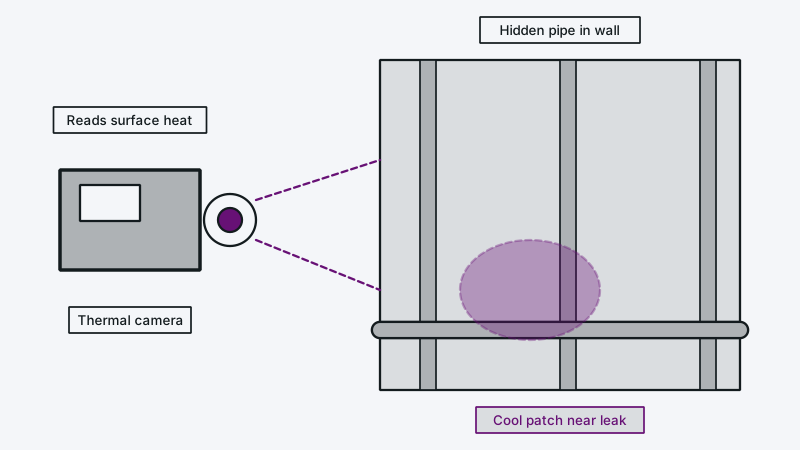
Infrared leak detection uses a thermal camera to show surface temperature patterns, and a wet area often looks cooler or warmer than the dry area around it. A plumber scans a wall, ceiling or floor, spots the odd patch and then confirms it with another tool. It is a good first look, not a final answer. This is one method among those described in our guide to leaks and burst pipes.
How does infrared water leak detection work?
A thermal camera records infrared radiation from surfaces and turns it into a color picture of temperature. A leak changes the temperature of the material it wets, so a damp patch shows up as a different color from dry material next to it. Wikipedia's article on thermography says the method is used in building inspection to find moisture in walls and roofs.
Why wet material looks different:
- Evaporation cools a wet surface. A damp wall under a running leak usually reads cooler.
- Hot water lines warm their surroundings. A leak on a hot supply or a hydronic line can leave a warm trail through a floor or wall.
- Wet material holds heat differently, so it warms and cools more slowly than dry material. This is why scans often work best when the temperature of the room is changing.
Wikipedia's leak detection article also lists infrared thermography as a method for finding subsurface leaks, because leaked fluid changes the surface temperature pattern above a pipe. The camera is the eyes. The plumber is the interpreter, who decides if a cold patch is a leak or just a cold spot above an exterior wall, a duct or a stud.
What can an infrared camera find in a house?
It can find leaks that wet or warm surfaces: a pipe leaking into a wall, a hot line under a slab floor, a wet ceiling below a bathroom, a damp patch under flooring and sometimes a roof leak. It does not find the leak itself. It marks the area to open or to check with a moisture meter.
Typical uses in a Valley home:
- A stain or smell with no visible source. The scan shows whether the moisture is a spot or a streak.
- A suspected hot water slab leak. Many Valley homes from the 1950s have copper lines in or under the slab. A warm spot on the floor can show on camera, which complements our page on slab leak detection.
- Wall and ceiling checks around showers, tubs and upstairs bathrooms.
- Radiant and hydronic lines, where the warm line is a clear signal when it leaks.
- Checking the extent of damage after a burst, which feeds into drying plans. See water damage from a burst pipe.
Most people who search for the equipment are choosing between buying a camera and hiring someone. For a one time problem, hiring is the better path, because the skill is in reading the image. Phone attachments and handheld units exist, but the camera is a tool, and the value is in knowing what a false reading looks like.
What are the limits of infrared leak detection?
It reads surfaces, not the inside of walls or the ground. Thick slabs, insulation, metal surfaces and shiny finishes hide or distort the picture. Wikipedia's thermography article lists limits such as camera cost, low resolution and temperature errors from emissivity and reflected radiation. Without a temperature difference, a leak shows nothing.
Cases that give false or missing results:
- Shiny or reflective surfaces. A mirror, polished metal or glossy tile can reflect heat from elsewhere and fool the image.
- Similar temperatures. On a day when the wall and the water are the same temperature, there is little contrast.
- Insulation and thick slabs, which blur or mute the heat signal.
- Condensation, plumbing noise and drafts, which make wet-looking patches that are not leaks.
- Old leaks that have dried, which can leave a stain but no temperature pattern.
Because of this, a sensible plumber does not trust one tool. They confirm a cold spot with a moisture meter, a pressure test or listening gear. Read our page on acoustic leak detection, and the meter method on leak detection with a water meter, for the other pieces.
How does infrared compare with other leak detection equipment?
Each method answers a different question. Meter and pressure tests say whether a leak exists. Acoustic tools say where on a pressurized line. Infrared says where moisture or heat has spread in a surface. Moisture meters confirm wetness at a spot. Camera inspections handle drains. Together they narrow a search so fewer holes are cut.
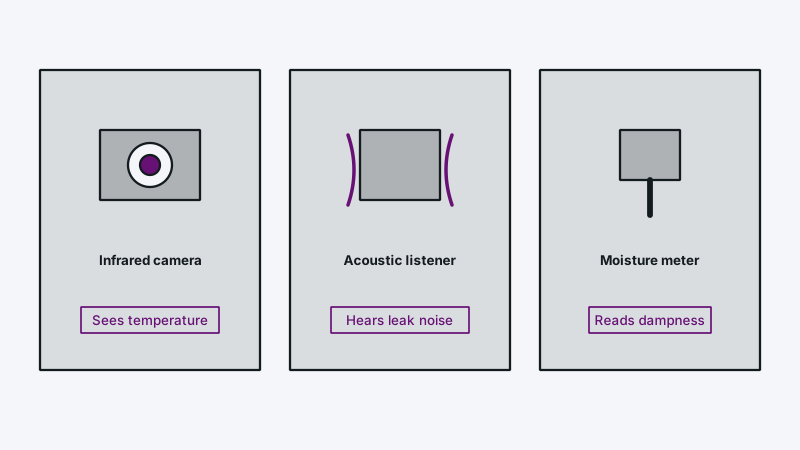
A comparison:
| Method | Best for | Weak at |
|---|---|---|
| Meter or pressure test | Confirming a supply leak exists | Saying where it is |
| Acoustic or ultrasonic | Pinpointing noise on pressurized pipe | Plastic pipe, drains, noisy sites |
| Infrared camera | Wet or warm patches in walls, ceilings, floors | Slabs, shiny finishes, low contrast |
| Moisture meter | Confirming wetness at a spot | Wide area scans |
| Drain camera | Sewer and drain damage | Pressure leaks |
For a hidden leak under or inside your home, the common pattern is meter first, then infrared and listening, then a small opening to confirm. If the leak is outdoors, read about underground water leak detection.
EPA WaterSense reports that the average family loses about 9,400 gallons a year to household leaks, which is why a good search before a repair pays off. To arrange a visit and a written quote, use our quote page.
Should I buy an infrared camera or hire a plumber?
For one problem in one house, hire. A camera that gives usable results is a significant purchase, and reading it takes practice. A cheap attachment can still help you check an outlet, a vent or an insulation gap, but it is a poor tool for slab and wall leaks. A plumber arrives with tools and experience.
If you do buy a unit, treat it as a screening tool:
- Scan in a stable room, with the heating or cooling steady.
- Take photos of dry areas for comparison.
- Confirm any suspect patch with a moisture meter, and with the water meter test.
- Do not cut into a wall on the camera's word alone.
If water is leaking now, do not scan, shut off the main valve first. Our page on what to do with a burst water pipe lists the order.
See everything we arrange on the Lankershim Plumbing home page.
Questions people ask
Can infrared find a leak behind a wall?
Often it can show the moisture or temperature change a leak causes on the wall surface, which points to the area. It cannot see the pipe or the exact break. A plumber confirms the spot with a moisture meter or a listening tool before opening the wall, which keeps the hole small.
Can infrared find a slab leak?
Sometimes, when a hot water line under the floor warms the surface above it. A cold water slab leak shows less, because there is little temperature contrast. Thick slabs mute the signal too. Listening tools and pressure tests are usually used together with the camera.
Is an infrared leak scan accurate?
It is good at showing where something is different, and weaker at saying why. Condensation, drafts, ducts and reflections look like leaks, and real leaks can hide in low contrast conditions. Accuracy depends on the camera, the conditions and the reader. Confirming with a second method is standard practice.
Does the camera work on any pipe material?
The camera does not read pipe material. It reads the surface above and around the pipe, so copper, PEX, galvanized and plastic all work if the leak changes the surface temperature. The pipe type matters more for other tools, such as acoustic listening, which struggles on plastic.
How much does infrared leak detection cost?
We have no sourced price to give, so we will not guess. The cost depends on the size of the area, the other methods used and whether it is part of a wider leak search. A local plumber quotes after a visit. Ask whether the scan is bundled into the leak detection fee.
References
Updated