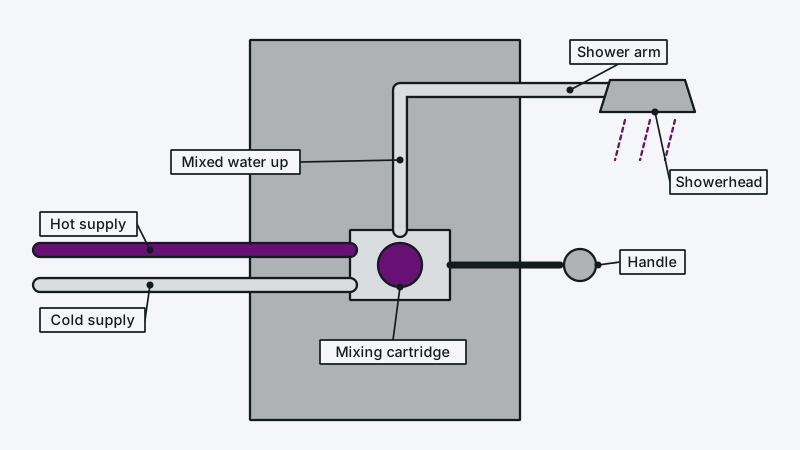
Open a hot tap at the kitchen or a bathroom sink. If it runs hot, the problem is in the shower: a worn mixing cartridge, a blocked valve or a faulty diverter. If every tap is cold, the water heater is the problem. That one test separates the two. It decides whether this is a plumber's repair at the wall or a heater job, covered in our water heater repair guide.
Why do I have no hot water only in the shower?
If sinks are hot but the shower is cold, the shower valve is mixing wrong or blocking the hot side. Mineral scale, a worn cartridge or a stuck anti-scald stop is the usual cause. Hot water that fades after a minute or two can also mean the heater is running dry, so test the other taps at the same moment.
The likely causes, in the order a plumber checks them:
- Worn or scaled cartridge. A single-handle valve has a cartridge that blends hot and cold. When its seals wear or scale builds up, it passes only cold, or hot and cold swap.
- Anti-scald limit set too low. Many valves carry a rotating stop that limits how far the handle turns toward hot. Wikipedia notes skin can burn in under five seconds at 140 degrees F, and these stops exist for that reason. A stop set for a cooler limit, or one that shifted during a repair, can leave the water barely warm.
- Diverter or tub spout faults. If the tub fills hot but the shower head is cold, the diverter is leaking mixed water.
- Blocked supply stop. A small valve behind the access panel may be partly shut after earlier work.
- Clogged showerhead. A badly scaled head restricts flow, and on a tankless heater the reduced flow may fall under the unit's minimum, so the burner never fires.
Older postwar homes in Burbank, Glendale and across the Valley often have valves from the 1950s to 1970s with threaded stems and rubber washers, which fail differently from modern cartridges. A plumber may recommend replacing the whole valve and not repairing it.
Why is the shower cold when the other taps are hot?
The shower is probably drawing from a different path than the taps, or its valve is faulty. Taps get unmixed hot water straight from the heater. The shower blends hot and cold, so a stuck valve gives a cold result while the sink works. A long pipe run to a far bathroom can also mean a long wait, but not a permanently cold shower.
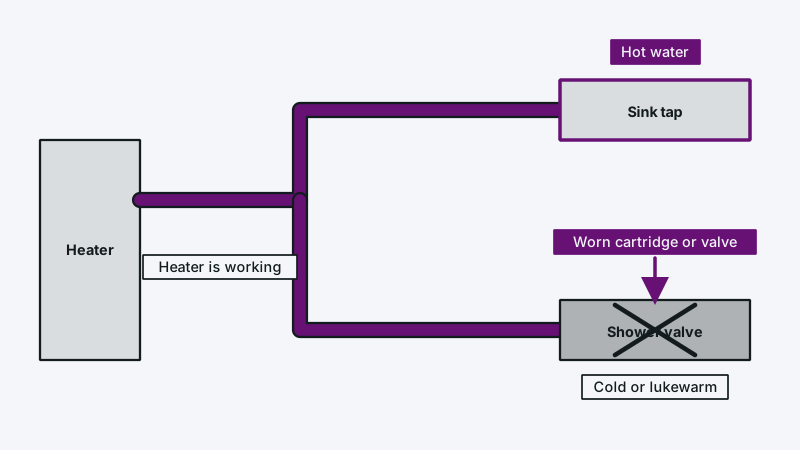
Try this quick sequence before you call anyone:
- Turn the handle all the way to hot and give it a full minute. A bathroom furthest from the heater can need that long to flush the cold water out of the line.
- Take off the showerhead and run the water. Scale inside the head, not the valve, may be the whole problem.
- Try the other showers or the tub. If one works fine, the fault sits with this valve.
- Notice whether the water starts warm and then turns cold. That points to the heater, not the valve. The next section covers it.
If the whole system is slow to deliver hot water, the heater may simply be far from the shower. That comes from the pipe layout and does not mean anything is broken.
What if all taps and the shower are cold?
In that case the water heater has stopped heating. On a gas model, confirm the pilot or igniter is working, the gas valve is open and the thermostat is switched on. On an electric model, look at the breaker and the heater's reset button. Water that runs warm and turns cold quickly means the tank is running out, or a part has failed inside it.
Start with the basics:
- Gas tank. Look at the control dial, and if your model has a viewing window, confirm there is a flame. A pilot flame that keeps dying points to a thermocouple or gas valve fault, which a plumber should handle.
- Electric tank. Check the breaker. If it trips the moment you reset it, leave it off and call for help.
- Tankless. Look for an error code on the screen and confirm the unit has power.
- Water quality. Sediment in a tank can crowd out hot water and leave you with a few minutes of warmth.
A thermostat set too low is also common. Bob Vila gives 122 to 140 degrees F as an ideal range, and says that after raising the setting hot water should return in 30 to 40 minutes. Be careful if you raise the temperature: past 140 the scalding risk climbs fast, most of all for young children and the elderly.
Longer reads on this branch are on why you may have no hot water and on the electric heater version.
Who fixes a shower with no hot water, and what does it cost?
A plumber replaces the cartridge or valve for a shower fault, and repairs or replaces the heater for a heater fault. Prices vary with the valve type and wall access. Published guides put a heater thermostat swap at about $150 to $200 and a gas control valve at $300 to $500. Take these as ballpark figures, because only your quote is the real price.
For a shower valve, the cost depends on whether the plumber can reach it from an access panel behind the wall or has to open the tile, and whether your valve brand still has parts. Swapping a cartridge is lighter work than replacing the whole valve. Get a written quote that includes any wall repair before the visit begins.
Fill in the quote form and a local plumber will be lined up for your address. Tell us how the other taps behave, which one runs cold, and the age of the shower valve, so the right cartridge is in the truck. For other services, start at the Lankershim Plumbing home page.
When the heater is the cause, repair is not always the best use of money. If it is over ten years old, water heater replacement may be the better call. Our page on how often a water heater should be replaced explains the timing.
Questions people ask
How long should a shower valve repair take?
Replacing a cartridge tends to take one to two hours when an access panel is there. Replacing the entire valve, particularly inside a tiled wall, may eat up half a day or longer, plus wall repair. Parts for older valve brands can stretch it further. After one look at the valve, the plumber can usually give you a time.
What should I ask a contractor about a shower that never gets hot?
Have them test the sinks first, so it is clear whether the shower or the heater is at fault. Get a written price for parts, labor and any wall repair, and ask whether they can match your valve brand. Check their California contractor license at cslb.ca.gov ahead of the job.
Does someone have to be home for the shower repair?
Yes. A person should be in the house to show which shower is affected and approve the work, and the water supply gets shut off during the work. Clear the tub and bathroom of bottles and toiletries. If the valve backs onto a closet or garage wall, leave a clear path to that side as well.
What turns a hot shower cold within minutes?
A shower that begins hot and then chills usually means the tank is emptying of hot water, the lower element or burner is weak, or sediment is eating up tank volume. A tankless unit may be tripping on scale or flow. A plumber can inspect the heater and say whether repair or replacement makes more sense.
Could a clogged showerhead be behind the cold water?
It can, mainly with tankless water heaters. When scale in the head drops the flow under the unit's minimum, the burner may not light and the water stays cold. Soak the head in vinegar or replace it, then test again. With a tank heater, a clogged head lowers pressure but leaves the temperature alone.
References
Updated