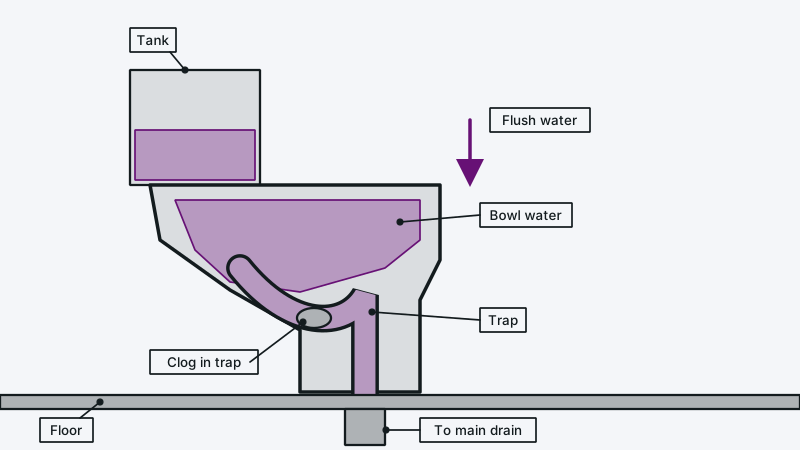
When a toilet fills to the rim and refuses to flush, the obstruction sits in the trap, the curved passage molded into the base. Let the water settle, then plunge using a flange model, which has a soft rubber sleeve under its cup, and keep the strokes firm and even. A closet auger gets past the trap when plunging fails. If more fixtures than one are draining badly, suspect the house line, which belongs with drain cleaning and hydro jetting.
What do I do first when the toilet is about to overflow?
Hold off on flushing. Take the tank lid off, press the rubber flapper shut so the tank quits sending water to the bowl, and twist the supply valve at the wall to the right. Should the level keep climbing, that valve is your shutoff. Lay down towels and wait for the bowl to settle before plunging.
Your first minute, step by step:
- Stop flushing. Each extra flush sends a whole tank into a bowl with nowhere to go.
- Open the tank and seat the flapper, or raise the float arm so refilling stops.
- Close the angle stop at the wall by turning it clockwise as far as it goes.
- Set towels and a bucket within reach and put on gloves.
A bowl that is full but holding steady can sit for a few minutes. Waiting sometimes works, since a partial blockage drains slowly on its own. Never pour a chemical drain cleaner into a full bowl. It floats in the standing water, can splash up, and has no effect on paper and waste lodged in a porcelain trap.
How do I use a plunger on a blocked toilet?
Reach for a flange plunger, never the flat-cup style meant for sinks. Fit the flange into the drain opening, check that water covers the cup (add some if it does not), press down slowly to expel trapped air, then pump hard in and out about 15 to 20 times without breaking the seal. A gurgle followed by a sudden drop in the bowl tells you the clog has shifted.
Flat-cup plungers let air escape around the toilet outlet, so they rarely work here. When the bowl is low, top it up until the cup is submerged, but not so far that it splashes over as you pump.
Three rounds with no movement is the time to quit. More plunging only shoves the same blockage back and forth, and the closet auger is the better tool next. Bowl and tank repairs are covered in our page on plumbing repair for a toilet.
When does a closet auger help, and how do I use it?
Sometimes called a toilet auger, a closet auger is a short cable housed in a stiff tube, with a bent tip that keeps the porcelain from getting scratched. Put the tip in the drain opening, crank the handle to drive the cable through the trap, catch or break up the blockage, then draw the cable out. One flush will show whether it worked.
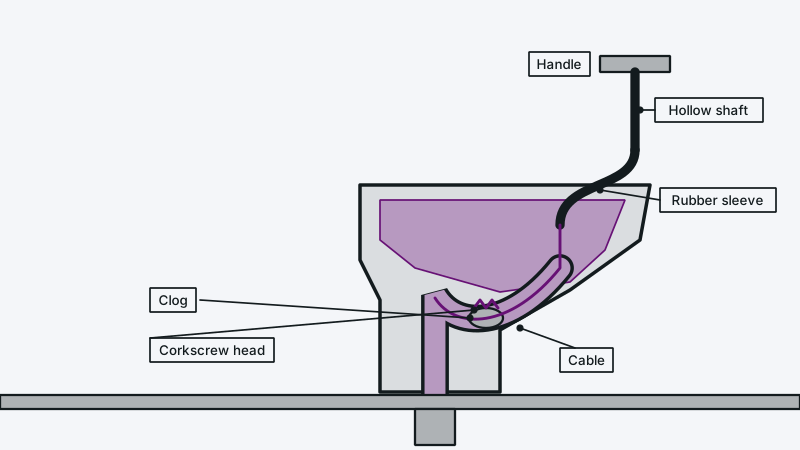
How to do it cleanly:
- Retract the cable into the tube, set the bent end in the bowl outlet and feed the cable in slowly.
- Crank clockwise while pushing gently. Once the cable meets resistance, keep cranking so it breaks up or hooks the blockage.
- Withdraw the cable, rinse it over a bucket, wipe it dry and store it.
- Flush one time. A strong, even flush means you are finished.
Skip the wire coat hanger, which scratches porcelain and rarely reaches the clog. A kitchen drain snake is too stiff for a toilet trap and can crack the bowl. If the auger hits something hard, like a toy or a hairbrush, stop there. Getting it out may mean lifting the toilet off the floor so a plumber can work from below.
What if the toilet keeps blocking or other drains are slow?
A toilet that blocks again and again, or a bathtub, a shower stall or a floor drain that gurgles and runs slowly at the same moment, means the fault lies further down the house line. An outdoor cleanout might even be spilling over. Quit running water throughout the home and phone a plumber. Roots working into aging clay or cast iron lines are a frequent culprit in Valley houses from the 1940s through the 1960s.
The lowest drain in the home, often the bathtub or floor drain, tends to show a main line problem first when someone flushes. Across Burbank and the nearby Valley, plenty of older lots have big trees with roots that creep into clay joints. A camera inspection reveals roots, a sag in the pipe, a collapsed stretch or plain buildup. Hydro jetting scours the whole pipe, while the camera shows whether a repair is needed. Our cost of hydro jetting page breaks down what drives the price.
Sewage rising through the floor drain or cleanout is not clean water. Keep kids and pets away, avoid touching it, and get a plumber out right away. Cleaning up after sewage belongs to a professional restoration company.
When should I call a plumber for a blocked toilet?
Make the call when two rounds of plunging plus the closet auger fail, when another fixture is slow or gurgling, when the toilet jams again within a few days, when water or sewage backs up through a drain in the floor, or when something hard went down the bowl. A professional can lift the toilet and sort it out.
Make the call too if the toilet wobbles on the floor or leaks around the base once you have plunged. The wax ring may have given way, and resetting the toilet is plumber's work. If sewage odor fills the room while the toilet sits unused, read the guide to sewer odor indoors.
Share the details on the quote page and we line up a local plumber to visit, with the price put in writing ahead of any work. Kitchen drains get their own walkthrough, unclogging a kitchen sink.
Questions people ask
How long does it take to fix a blocked toilet?
Plunging runs a few minutes, and an auger adds roughly 10 to 15 more. A plumber opening the toilet or the line generally wraps up inside an hour. Pulling the toilet to retrieve a lodged object, or jetting the main line, stretches the appointment.
What should I ask before I hire a plumber for a blocked toilet?
Find out if the price includes pulling the toilet when needed, running a cable or camera down the line, and fitting a fresh wax ring and bolts after a reset. Ask how the figure is calculated and have it in writing before anyone starts. Say what went down the bowl.
Do I need to be home for the visit?
Someone responsible has to let the plumber in if you cannot. The plumber needs the bathroom open and may lift the toilet, run water and test flush. Clear the floor around the toilet and mention what you have already tried.
Can I use a chemical drain cleaner on a toilet?
Avoid it. Caustic cleaner in a full bowl can splash, burn skin and eyes, and does nothing to a solid blockage. After any exposure, ring 1-800-222-1222 for Poison Help, and dial 911 if breathing is difficult. Let the plumber know if you used one.
What should never be flushed?
Toilet paper and human waste are the only things that belong in a toilet. Wipes sold as flushable, paper towels, hygiene products, cotton, dental floss and cat litter regularly block the trap and the house line. Put them in the trash.
This guide is one of many on Burbank plumber.
References
Updated