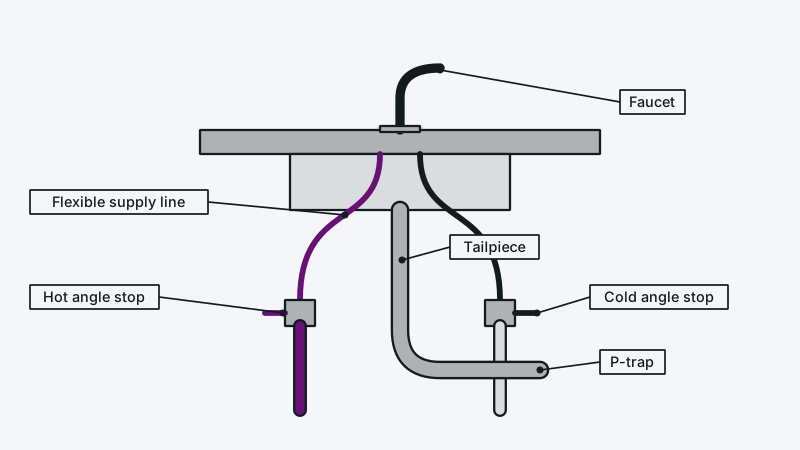
The first question is whether the cold water is only at the kitchen sink or everywhere. If every hot tap in the house is cold, the problem is the water heater, and our hub on water heater repair in Burbank is the place to start. If the bathroom gives hot water and the kitchen does not, the heater is working and the fault sits in the pipe, valve or faucet between it and that one sink.
Why is there no hot water at my kitchen sink but hot water everywhere else?
When only one faucet is cold, the usual causes are a blocked faucet aerator or supply hose, a failed faucet cartridge, a closed or clogged hot-side shutoff valve under the sink, or a long pipe run where the hot water has not arrived yet. Every one of these sits at the sink, so the water heater itself is almost always fine.
In Valley homes built from the 1940s through the 1960s, the kitchen tends to be at the opposite end of the house from the heater, which sits in the garage or a back closet. Long runs of old galvanized or copper supply pipe can be partly choked with mineral scale, which reduces hot flow to a trickle at the most distant fixture while the closest bathroom runs fine.
In practice the causes line up like this:
| Symptom | Probable cause |
|---|---|
| Hot is weak, cold is strong, aerator has grit in it | Debris or scale in the aerator or hose |
| Handle moves but water stays cold at every setting | Worn cartridge or mixing valve in the faucet |
| Cold only after you used the dishwasher or washer | Shared hot line, flow shortage, or a check valve problem |
| Takes minutes to get warm, then fine | Long pipe run, no recirculation |
| Hot on one side of a two-handle faucet, nothing on the other | Valve, handle stem or supply stop |
What can I check in five minutes before I call anyone?
Begin under the sink. Make sure the hot shutoff valve, the left one on a standard layout, is fully open, then unscrew the faucet aerator and rinse it out. After that, run only the hot side for two minutes. That clears up most of the simple causes with nothing more than a wrench or pliers.
A sensible order:
- Run the hot tap in the bathroom nearest the heater. Hot water there means the heater is working.
- Open the cabinet beneath the kitchen sink and turn the hot shutoff valve counter-clockwise to be sure it is all the way open.
- Unscrew the aerator on the end of the spout, clean the screen, and screw it back on.
- Let the hot side run for two to three minutes. A long pipe run needs that much time to deliver.
- Push a single-handle faucet fully to hot. With a two-handle faucet, test one handle at a time.
- Unscrew a pull-down sprayer head and flush the hose, because the sprayer's check valve can clog.
If the water turns hot after step three or four, that was the cause. If not, suspect the faucet cartridge or the supply line next.
Could the faucet itself be the problem?
Yes, and it ranks among the most frequent reasons. Single-handle kitchen faucets mix hot and cold inside a cartridge. Once the cartridge wears out or jams with debris, the hot side can stop delivering even though the supply line is full of hot water. Swapping the cartridge is a plumber's job that often takes under an hour.
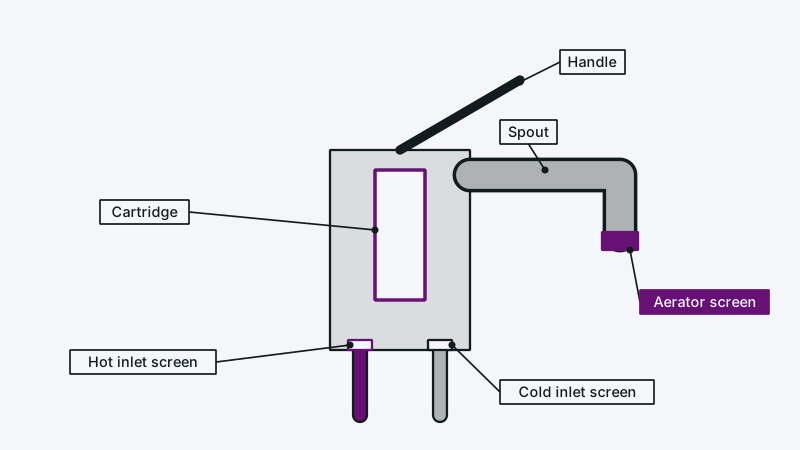
The supply hoses between the shutoffs and the faucet can also kink, or their inner liner can fail and restrict flow. Braided hoses from the 1990s and 2000s are known to degrade inside while looking fine outside. New hoses are cheap and quick to fit, and if the faucet is so old that parts are scarce, a whole new faucet can cost about what the repair would.
To see what a faucet replacement involves, our page on replacing a faucet sets out what drives the cost.
Is it the water heater after all?
It can be, in a few cases. A heater close to failing may run out of hot water sooner than normal, and the kitchen, being last on the line, goes cold first. A gas water heater whose pilot has gone out, or an electric heater with a failed element, can leave you with only what hot water remains in the tank.
If the heater is the culprit and it is worn out, the next step is a water heater replacement. Some owners take that chance to consider tankless water heaters, which heat on demand with no storage tank but need a larger gas or electric supply. Pricing for either depends on your house.
Signs pointing at the heater:
- Hot water for a short while, then cold, at every sink and shower.
- The kitchen goes cold right after someone showers.
- The tank is old, leaking or noisy. See how often a water heater needs replacing.
- Water audibly runs through a pipe yet the tap stays cold, which can indicate a crossover.
A crossover is a plumbing error or failure where hot and cold supplies blend inside a fixture or valve, so opening one side delivers the other. It is rare, and appears as a faucet running lukewarm water with only one side open. A plumber locates it by closing each shutoff one at a time.
When the heater itself is at fault, our no hot water from the shower guide goes through the electric and gas causes.
When should I call a plumber?
Phone a plumber once the aerator and shutoffs check out, the cartridge needs replacing, or you suspect a pipe fault behind the wall. Also call if the cold sink arrived with low pressure elsewhere, damp cabinets, or weak hot flow everywhere in the building, since those can mean a leak or a failing valve.
Before any work begins, the local plumber hands you the price in writing. Start a visit on our quote page. For a sense of the jobs we line up across the Valley, see the Lankershim Plumbing home page.
A typical visit includes:
- Measuring temperature at the heater and the nearest fixtures to pin down where the problem starts.
- Testing the shutoff valves and supply lines for restrictions.
- Pulling the faucet cartridge to inspect it.
- Reviewing the pipe layout if the sink is far from the heater, and discussing options such as a recirculation setup if long waits are the complaint.
Questions people ask
Why does the bathroom run hot while the kitchen sink stays cold?
The fault is confined to the kitchen. The water heater works, but something between it and that sink restricts flow or blocks the hot side. Typical suspects are a clogged aerator, a worn faucet cartridge, a partly closed shutoff valve, or a clogged supply hose. A plumber can find it in a short visit by testing them one after another.
Why does my kitchen sink take so long to get hot?
The pipe from the heater is long, and the water standing in it has gone cold. The further the sink sits from the heater, the longer you wait. Older Valley homes with the heater in the garage often have this. Insulating the hot pipe helps slightly, and a recirculation pump fixes it properly, though that is a bigger job a plumber has to quote.
Can a clogged aerator cause no hot water?
Yes, though only in part. A clogged aerator restricts flow on both sides, and it shows most on the hot side when cold pressure is stronger. Unscrew the end of the spout, rinse the screen and put it back. Where water is hard, a soak in white vinegar clears most scale from the aerator.
Is no hot water at one sink an emergency?
Usually not. If the rest of the house has hot water and nothing leaks, it can wait for a scheduled visit. Treat it as urgent if you see water damage under the sink, hear water running inside a wall, or lose hot water in the whole house at once. In those cases shut off the water supply at the main valve.
Must I stay home for the visit?
A person needs to be in the house to open up the kitchen, point out the shutoff valves, and confirm the fix. If the sink is easy to reach and an adult can approve the work by phone, you may be able to skip the full visit, but ask when you book.
References
Updated