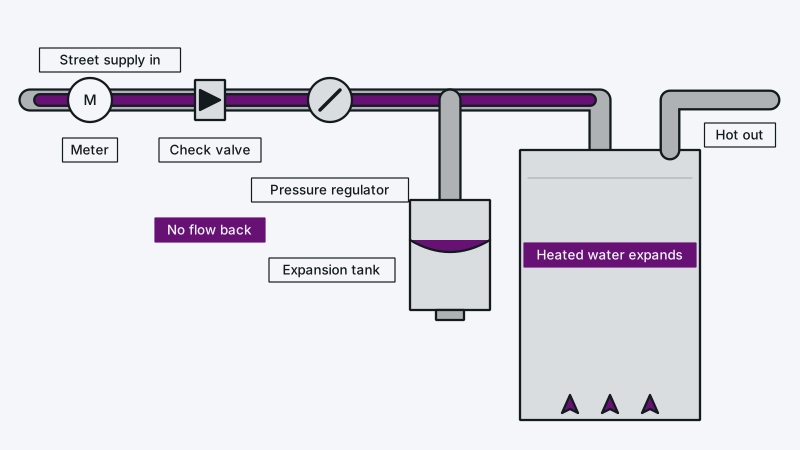
Water expands when it heats. In a house where it can push back into the street main, that goes unnoticed. Where a check valve or regulator sits at the meter, the expanding water is trapped, and pressure jumps each time the heater fires. A small tank with an air cushion absorbs that. This page covers when it fails and how it gets replaced, alongside our hub on water heater repair in Burbank.
What does a water heater expansion tank do?
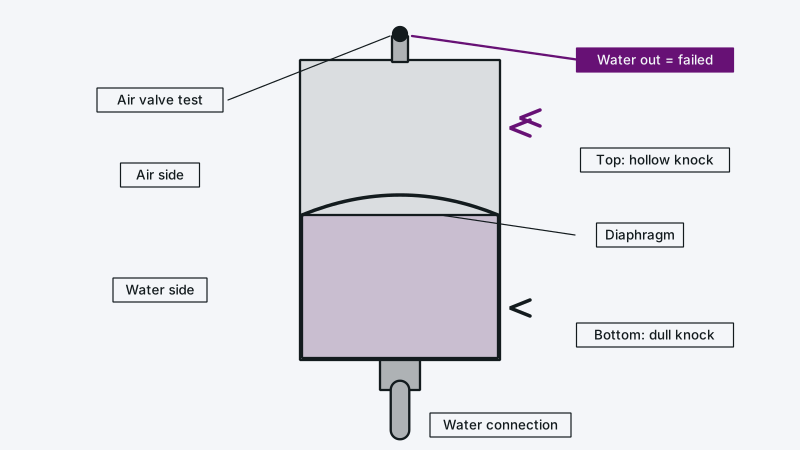
It absorbs the extra volume of water as it heats, so pressure in the pipes does not climb. A rubber diaphragm divides the tank, air on one side and water on the other. When pressure climbs, water is forced into the tank and squeezes the air. Once the water cools, that air pushes it back out.
The need arises in what plumbers call a closed system, where a backflow preventer, check valve or pressure regulator stops expanded water from flowing back toward the street. Many homes built or updated in recent decades have one at the meter. To learn if your house is closed, a plumber looks for the device at the meter and takes a pressure reading.
Tankless water heaters can need one too, if the system is closed. Without the cushion, hot water pressure spikes can make the relief valve drip, shorten the life of the tank and fittings, cause banging in pipes and stress faucets and appliance valves. For more on the relief valve, see pressure relief valve replacement.
How do I know my expansion tank has failed?
Watch for a dripping relief valve, pressure that surges when the heater runs, banging pipes, a tank that feels heavy and waterlogged, and water squirting from the air valve. Tapping the tank is a fast test: a good one rings hollow near the top and dull near the bottom, while a dead one sounds dull everywhere.
Checks you can make:
- Tap test. Knock on the top and then the bottom of the tank. A hollow top and a solid bottom is normal.
- Valve test. Press the small air valve, like a tire valve, on the tank. If water comes out, the diaphragm has ruptured and the tank is finished.
- Look for rust. A rusty or damp tank, or a stained shutoff, points to a leak at the fitting.
- Watch the relief valve. Drips that come and go with heating cycles are a classic sign.
- Pressure gauge. Screw a gauge onto a hose bib and watch whether the reading climbs above its resting level while the heater runs.
Expansion tanks do not last as long as the heater. Many get swapped once or twice during a house's lifetime. If yours has never been touched and the house has a closed system, it is worth a look.
Can I replace the expansion tank myself?
A careful owner can manage it, though the air pressure setting is the step people skip, and water heater work raises permit and code questions. The sequence is to shut the water off, release pressure, match the new tank's air charge to your supply, and connect it. Unsure? A plumber finishes the job in under an hour.
Steps a plumber follows:
- Switch off the heater's gas or power, close the cold supply valve, and run a hot tap to bleed off pressure.
- Drain a little water from the heater's drain valve to lower the line level, so nothing pours out when the old tank comes off.
- Unscrew the old tank, usually a three-quarter inch connection on a tee in the cold line.
- Read the home's water pressure from a gauge threaded onto a hose bib.
- Use a tire gauge to bring the new tank's air charge in line with the water pressure. A new tank often arrives charged to a standard factory pressure that is not right for your house, and it must be adjusted before it goes on.
- Install the new tank with thread sealant, brace it if it hangs, turn the water back on, bleed out air, and look for leaks.
Do the air check before connecting. Setting it after water is in the tank gives a wrong reading.
What size of expansion tank do I need?
Size depends on the tank volume, the water pressure and the temperature setting. A typical residential tank of about forty to fifty gallons often takes a small expansion tank of a few gallons, and a plumber picks from the manufacturer's chart using your numbers. Do not guess, because an undersized tank does not do its job.
Questions the plumber will ask or measure:
- How many gallons is the water heater?
- What is the static water pressure at the house?
- Is there a pressure regulator, and what is it set to?
- Is the tank to be mounted vertically from the pipe, or supported from below? Many makers want support on larger tanks.
Houses with a pressure-reducing valve can still see pressure creep too high in some Valley neighborhoods, especially lower-lying ones. For the opposite problem, read why water pressure is low; a high reading is its own issue to bring up with the plumber.
Is an expansion tank required, and does it need a permit?
The plumbing code requires a way to control thermal expansion in a closed system, and inspectors check for it on a new water heater installation, as part of the permit. We have not confirmed the exact code text for Burbank or Los Angeles, so put that question to the plumber or the Building Division for your address. Replacing only the tank often needs no permit, but a full heater replacement does.
For permits and who issues them, see permits for water heater replacement. If your heater is being replaced anyway, ask the plumber to check or replace the expansion tank in the same visit, since the water is already shut off and the heater drained.
In California, water heaters also need seismic bracing, and an expansion tank adds weight on the pipework. Ask the plumber to support it correctly. A new water heater installation that includes the tank, strapping and relief line is what an inspector wants to see.
What does an expansion tank replacement cost?
The tank costs little next to the heater and the labor is brief, which puts this near the cheap end of plumbing work. The price rises if the connection is corroded, the tank must be supported, the shutoff is not working, or the plumber has to add a tee. We do not print a flat price because it depends on your fittings.
Get a written price itemizing the tank, any new fittings or shutoff, and labor. For wider heater pricing, read water heater replacement cost. To price your own house, use our quote page. How it works walks through the steps, and the Lankershim Plumbing front page shows our other work.
Questions people ask
How many years does an expansion tank last?
Lifespan depends on the water, the pressure and how the tank is built, and most houses see at least one replacement over their lifetime. Because they are cheap compared with the heater, many plumbers replace it when they replace the heater. Check yours with a tap test and an air valve check if the relief valve starts to drip.
How can I tell an expansion tank has gone bad?
Typical signs: the relief valve drips while the heater runs, pipes bang, a gauge shows pressure spikes, water sprays from the tank's air valve, or the tank sounds dull throughout when tapped. If you see more than one, replace the tank, and have the plumber check the water pressure and the relief valve.
Can I run my water heater without an expansion tank?
On an open system, one without a check valve or regulator, many homes do. On a closed system, the pressure has nowhere to go and the relief valve or fittings take the strain. A plumber can confirm which you have, and the code may require the tank on a new installation.
Do I have to set the air pressure on a new expansion tank?
Yes. The air charge has to equal your home's water pressure, and new tanks often ship at a factory default that differs. Test it with a tire gauge before installing and add or release air as needed. A wrongly charged tank will not do its job.
Must someone be home while the tank is swapped?
Usually, yes, since the water is shut off for part of the appointment and the heater must be reachable. Most jobs run under an hour. For a heater in a locked space, set up access ahead of time, and before the plumber leaves check that water is flowing again and the connections are dry.
References
Updated