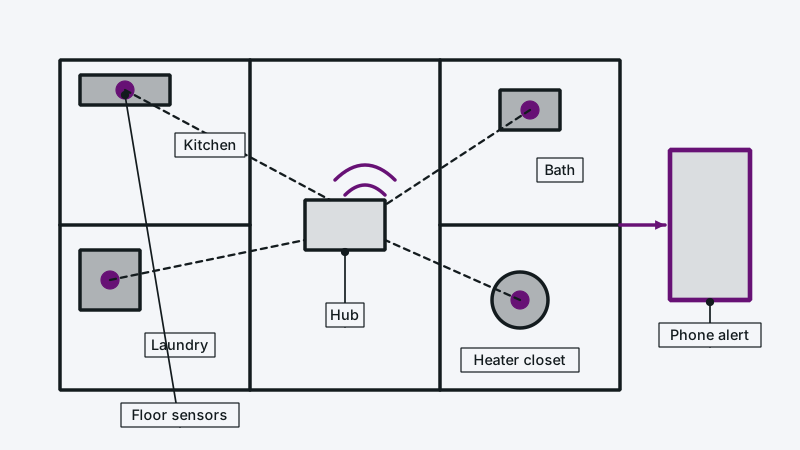
Smart water leak detection means a connected device that watches for moisture in the wrong place, or for water use that looks abnormal, and pushes an alert to your phone. The best known kinds are puddle sensors, flow monitors on the main line, and automatic shutoff valves. They help most when you travel or when a leak could run unseen. See our guide to leaks and burst pipes for the wider picture.
What kinds of smart water leak detectors are there?
There are three main kinds. Puddle sensors sit on the floor and alarm when they get wet. Flow monitors clamp onto or sit in the main line and learn your usage, then alert on a pattern that looks like a leak. Automatic shutoff valves do the same and close the main. Utility meters can add alerts too.
How they compare:
| Device | What it does | Best for | Limits |
|---|---|---|---|
| Puddle sensor | Alarms when water touches it | Under sinks, behind toilets, by the water heater | Only sees water at its own spot |
| Flow monitor | Tracks usage on the main and flags odd flow | Whole-house watch | Slow drips can hide in normal use |
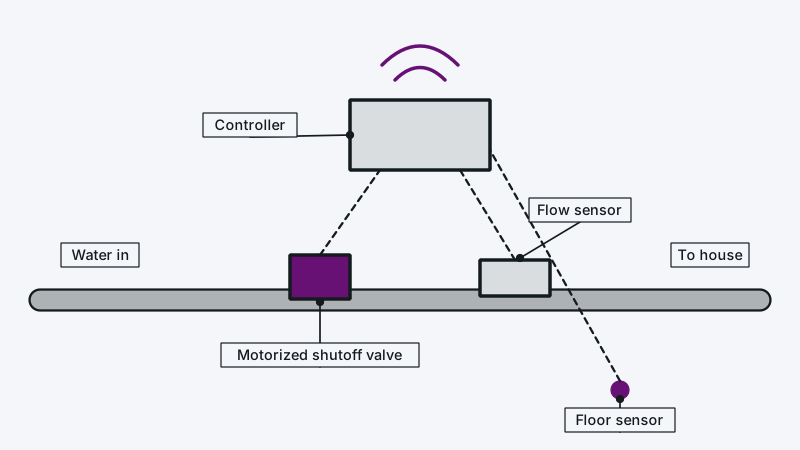
| Automatic shutoff | Flow monitor plus a valve that closes | Travelers, second homes, big bursts | Needs a plumber to fit, depends on power and signal |
| Pipe-mounted acoustic sensor | Listens for leak sounds on a pipe | Catching small changes early | Less common, signal can vary |
| Utility smart meter alerts | Reports continuous flow from the meter | Underground and slab leaks | Depends on your utility's program |
Wikipedia's leak detection article explains that pressure and flow monitoring can reveal leaks because a leak changes the system's hydraulics, and that acoustic sensors learn a baseline of normal noise and raise an alarm on a deviation. Home devices apply the same ideas at a small scale.
Do I need a Wi-Fi leak detector, or will a plain alarm do?
A plain battery alarm beside the water heater, washer and sinks is a good, cheap start, because it makes a loud noise when it gets wet. A Wi-Fi version sends the alert to your phone, which matters if nobody is home. Check that the signal reaches the place you put it, since a garage or a closet can be a weak spot.
Points to weigh:
- Alerts away from home. Only a connected device can tell you about a leak while you are traveling.
- Reliability. Wi-Fi drops, batteries die and apps change. Pick a device with a local alarm too, and replace batteries on a schedule.
- Where you put it. Low spots next to likely leak sources: the water heater, the washer, dishwasher, sinks, toilets, the fridge and under the AC drain.
- Number of sensors. One is not a system. Many homes put a sensor at each risk spot.
- Privacy and subscriptions. Read what the device sends and whether features need a paid plan.
If your concern is a leak that has already started, the steps in what to do with a burst water pipe are the place to start, and the meter check on leak detection with a water meter costs nothing.
Is an automatic water shutoff valve worth it?
For a home that is empty for days, or where a burst could flood a floor above living space, it often is. The valve is fitted on the main line by a plumber and closes when the monitor sees a pattern it reads as a leak. A slow drip will not trigger it, and it can close at an awkward moment. You will need to know how to override it.
What a plumber looks at before fitting one:
- Where the main is, how much space there is and what pipe material it is, such as copper, galvanized steel or PEX.
- Water pressure. High pressure strains every fitting. A pressure regulator may be worth adding.
- Power and signal. A valve may need a plug or a battery, and a Wi-Fi reach.
- Irrigation and pools. These draw large flows that a monitor must learn so it does not shut off at the wrong time.
- Permits. Tampering with the main line can require one. Check with the Burbank Building Division, or LADBS in the Valley's Los Angeles neighborhoods.
A shutoff valve does not replace a good valve you can reach and turn by hand. Test the manual shutoff first, as covered in our guide to burst pipe prevention.
How good is smart leak detection at finding small or hidden leaks?
It is good at big, sudden problems and mixed at small ones. A burst or a stuck toilet shows as heavy flow and triggers fast. A slow drip or an underground seep may blend into normal use. For those, a meter check, a pressure test or acoustic equipment is a better tool.
EPA WaterSense reports that the average family loses about 9,400 gallons a year to household leaks, and that a well maintained irrigation system matters too, since a poorly maintained one can waste up to 25,000 gallons a year. Most of that loss is a slow leak, not a burst, so check both.
A layered approach works best:
- Meter check every few months, using the steps in our guide to leak detection with a water meter.
- Puddle sensors at the risk spots.
- A flow monitor or shutoff if you travel or have a high-value space below a bathroom.
- A plumber visit for anything the devices point to but you cannot find. See acoustic leak detection and infrared leak detection.
If you need a pro to fit a device or find a leak, send a request through our quote page and a visit, with the price in writing, will be set up.
Can a smart device lower my insurance cost?
Some insurers offer a discount or incentive for a water leak sensor or shutoff, but it varies by insurer, state and policy, and we have not confirmed any. Ask your insurer before you buy. They may specify the kind of device and require proof of installation, and fitting a device leaves the policy's coverage as it was.
Questions for your insurer:
- Do you give a discount for a leak sensor or an automatic shutoff?
- Does the device have to be professionally installed?
- What documentation do you need?
- Does the device change my coverage for a burst pipe? Read our page on whether a burst pipe is covered by insurance.
More plumbing topics are on the Lankershim Plumbing home page.
Questions people ask
What is the best smart water leak detector?
It depends on the need. A set of puddle sensors suits renters and low cost setups. A flow monitor with an automatic shutoff suits a home that is empty for long stretches. We do not rank brands, because we have not tested them. Choose by where the risk is, the signal, power and the plan fees.
Can a smart leak sensor find a slab leak?
Not by itself. A puddle sensor needs water at its spot, and a slab leak may never reach it. A flow monitor or utility alert can show continuous flow, which then calls for a meter check and a plumber with listening and pressure tools. See slab leak detection.
Do I need Wi-Fi for a leak detector?
Not for a local alarm, but you do for phone alerts. Keep a battery-powered alarm that sounds on its own, and add a connected one if you want alerts while away. Test the signal at the install spot, and check batteries on a schedule.
Will a smart shutoff valve stop the water in a burst?
It can, if the monitor sees the flow, the valve has power and the signal works. It is not instant. A burst can release water for seconds or minutes before the valve closes. Pair it with a manual main shutoff you can reach, and know how to override the device.
Can a plumber install a leak sensor or shutoff for me?
A puddle sensor you can place yourself. A shutoff valve goes on your main line, so a local plumber should fit it, and a permit may apply. Ask what device they use, how it is tested, how you override it and what happens in a power or Wi-Fi outage.
References
Updated