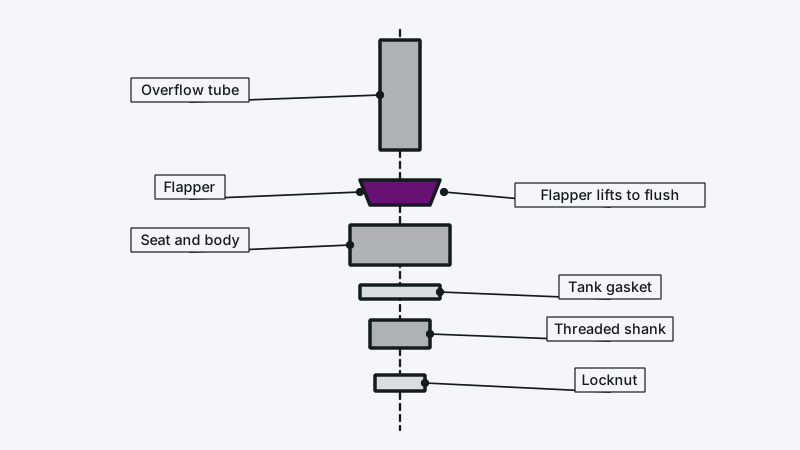
Fixing a flush valve falls into one of three jobs: cleaning or resurfacing the seat under the flapper, swapping a worn flapper or canister seal, or lifting the tank to fit a complete new valve. The right choice follows from where the leak or weak flush originates. This is a spoke of our toilet repair guide, and it picks up where simple flapper and handle fixes stop.
What does a toilet flush valve do?
The flush valve is the drain opening in the floor of the tank. When you push the handle, a seal lifts, the stored water rushes into the bowl through that opening, and the seal drops back to close it. The same part carries the overflow tube, which sends excess water down the drain if the tank ever overfills.
Two designs are common. In the older flapper design, a rubber flapper hinged to the overflow tube covers the opening. In a canister or tower design, a sliding cup lifts around the tube and drops back to seal. Both rely on a clean seat and a flexible seal. The flush valve also decides how fast the water leaves the tank, which affects how well the bowl clears.
How do you know the flush valve has failed?
Refilling with nobody flushing, a flush that quits early, or a crack or crust at the opening all implicate the flush valve. Add food coloring to the tank, wait ten minutes without flushing and check the bowl. If color shows up even with a new flapper, the seat is damaged or the valve has failed.
Other clues:
- A faint trickle you can hear in the tank when the house is quiet
- A flush that starts strong and fades, because the seal drops early
- Water leaking under the tank, where the valve passes through the tank floor
- A rough, pitted or scaled ring where the flapper rests
- Rust, mineral crust or green stains from older toilets in homes with hard water
The EPA names worn flappers as a common cause of silent toilet leaks, so replace the flapper first. If the leak continues, the valve body or seat is next.
How do you repair the seat without replacing the flush valve?
Clean the seat with a non-scratching pad and a little vinegar, rinse it, dry it, and fit a new flapper. If the seat is pitted, a seat repair kit that bonds a new sealing ring on top of it can work, as long as the valve body itself is sound and the tank does not leak underneath.
How those kits work and where they fall short is explained in replacing a flush valve without removing the tank. A resurfaced seat is a patch. On an old toilet with a valve crusted over, full replacement holds up longer.
How do you replace a canister style flush valve?
Turn off the water, flush to drain the tank, then lift the canister off the tower by releasing its latch or twisting it free. Fit a new canister or seal, adjust the height so it sits fully down on the base when the chain or float rod is relaxed, and test the flush. Parts differ by maker, so match the model.
On many canister designs, the seal is a rubber ring at the bottom of the cup, and it is the part that wears. Replace it with the maker's part, and check that the adjustment collar sits at the height the instructions give. If the cup does not seat fully, the toilet runs. If the tower itself is cracked, the whole flush valve needs replacing.
How do you replace the whole flush valve?
Close the supply and empty the tank, detach the supply line, take out the tank bolts, lift the tank away, unscrew the large locknut under the tank, pull out the old valve, fit the new valve with its gasket, set the tank back on a new tank to bowl gasket, tighten the bolts evenly, reconnect and test for leaks.
A published repair guide lists the same sequence and adds that a tank with a short overflow tube needs a new flush valve assembly. It rates the job as intermediate. On most standard toilets a plumber finishes the whole valve in one visit.
A few practical points:
- Replace the tank to bowl gasket at the same time, since you have the tank off already.
- Tighten bolts alternately, a little at a time. Uneven force cracks the tank.
- Use a flush valve sized to your drain opening, 2 inch or 3 inch.
- Wipe the tank floor clean and dry before fitting the new valve, so the gasket seats.
- Test for leaks with dry paper before putting the lid back.
In Burbank and Glendale homes from the postwar years, toilets can be forty years old or more. Rusted bolts or fragile porcelain make lifting the tank a risk, and it is reasonable to leave that to a plumber.
How do you repair a toilet flush handle that sticks or does not lift?
Open the tank and watch the lever arm when you push the handle. If the arm moves and nothing else does, the chain or lift wire has slipped. If the arm does not move, tighten the mounting nut, which often turns the opposite way from what you expect. Replace a cracked or corroded handle with one that has the same mount type.
The handle and flush valve work as a pair: the handle lifts the seal through the chain or rod, and the flush valve closes behind it. A chain too short holds the seal open, and one too long weakens the flush. Our guide to fixing a toilet flush button or handle covers the mechanisms, including toilets with no chain.
What about a float valve?
The float valve is the other name some people use for the fill valve, not the flush valve. It controls the water coming into the tank and stops it at the right level. If the tank overfills and runs into the overflow tube, the float or its adjustment is the problem, not the flush valve.
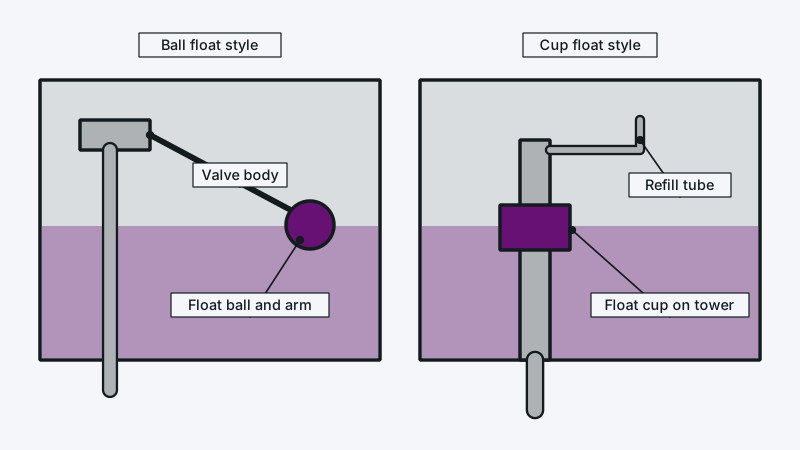
If that matches your toilet, read repairing a toilet fill valve. The two are easy to confuse, since both sit in the tank and both can cause running. Here is the test: water spilling into the overflow tube points to the fill valve, while a correct level with a toilet that still tops up points to the flush valve and flapper.
Is flush valve repair worth it, or should you replace the toilet?
If the toilet's porcelain is sound, a new flush valve is a low cost fix that restores a leaking tank for years. If the toilet is cracked, severely stained, or old enough to use a lot of water per flush, replacement may pay back. New toilets in California are capped at 1.28 gallons per flush, and the EPA says a WaterSense labeled toilet can save the average family about 13,000 gallons a year.
That saving is an average, so your own depends on how old your toilet is and how many people use it. For the cost side of the decision, see our page on toilet replacement cost.
When should you call a plumber?
Bring in a plumber when the tank leaks at the base, the bolts are seized, the toilet is old and brittle, the shutoff will not close, or a new flapper and seat repair failed to stop the leak. Valve and gaskets can be swapped in one visit.
Give us the toilet type and the symptom and we will line up a local plumber anywhere around Burbank and the Valley, with the price in writing first. Request a quote to begin, or see our other services on the Lankershim Plumbing home page.
Questions people ask
What causes a toilet flush valve to fail?
Rubber seals harden with age, mineral scale roughens the seat, and cleaning tablets or chemicals can attack the parts. Hard water speeds this up. The result is a seat that no longer seals, so water seeps out of the tank and into the bowl while the tank tops itself up.
Can I replace a toilet flush valve myself?
Yes, if hoisting the tank off the bowl and tightening bolts evenly does not worry you. It is an intermediate job and the main danger is cracked porcelain. Rusted bolts, a cracked tank or plain caution are good reasons to let a plumber do it in a single visit.
How long does a flush valve repair take?
A seat clean and flapper replacement takes about 15 to 30 minutes. A full flush valve replacement, with the tank lifted off, takes about an hour for a first timer, less for a plumber. A seized shutoff valve or rusted bolts add time.
Do all toilets use the same flush valve?
No. The opening is usually 2 or 3 inches across, and tanks differ in design, including flapper, canister, dual flush and pressure assisted types. Take the old valve or the model name with you when you buy a replacement, or ask for the maker's part.
Why is my toilet flush weak?
Usual culprits are a low water level in the tank, a flapper that drops too soon, a clogged rim, or a partly blocked drain. Check the water level against the mark and lengthen the chain slightly. If the bowl still clears poorly, the drain may be partly blocked and needs a plumber.
References
Updated