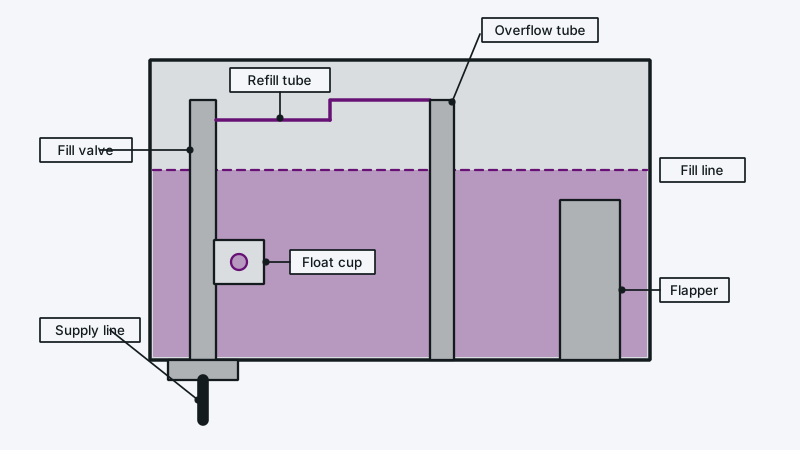
Fixing a toilet fill valve means closing the wall valve, emptying the tank, unscrewing the worn valve from below, and installing a fresh one at the correct height. Most homeowners are done inside an hour. This page belongs with our toilet repair guide for Burbank and the San Fernando Valley, and it goes through the symptoms, the swap, the supply line and the water bill.
How do you repair a toilet fill valve?
Swapping beats repairing here. Close the shutoff, flush the tank empty, detach the supply line, back off the locknut beneath the tank, pull the old valve out, set a new one in, adjust the height, reconnect and test. Fill valves are inexpensive sealed units, and opening one up seldom cures anything.
The sequence in more detail follows. First lay a towel on the floor and keep a small bucket and sponge close, since a tank never drains fully.
- Twist the oval handle of the shutoff valve at the back of the toilet to the right until it will not go further.
- Flush once and hold the handle down. Sponge out the last inch of water.
- Unscrew the plastic nut that joins the supply line to the bottom of the valve. Fingers are usually enough to loosen it.
- Unscrew the large locknut under the tank, outside, at the base of the valve. The old valve now lifts out through the tank.
- Set the new valve into the same hole and adjust its height to the maker's mark. The valve top, or its critical level line, has to sit higher than the rim of the overflow tube.
- Hand tighten the locknut, then a quarter turn more. Cranking harder risks cracking the porcelain.
- Reattach the supply line, snap the small refill tube onto the overflow tube, and bring the water back on gently.
Keep the lid off and watch the first fill. Water ought to stop roughly one inch lower than the overflow tube's rim, or at the waterline mark molded into the porcelain.
How do you know the fill valve is the problem?
Typical signs include a hiss once the flush has ended, a tank that tops itself up every few minutes while nobody touches the toilet, or a tank that never seems to stop filling. If water trickles into the overflow tube, the valve is not shutting off at the right level or has stopped sealing.
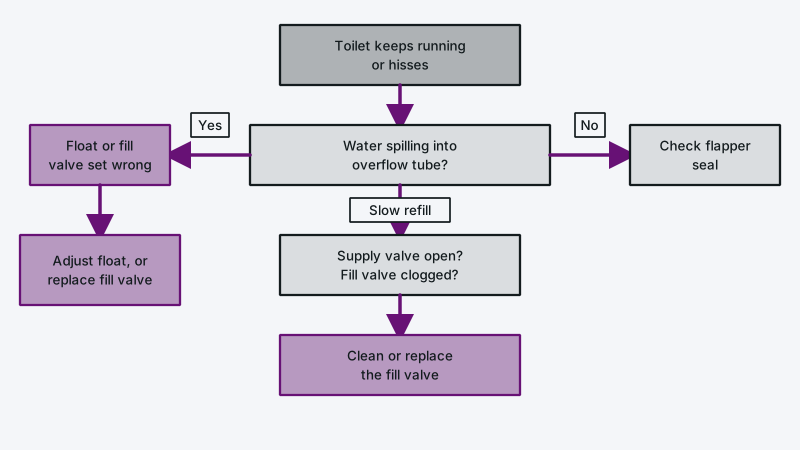
Sort the cause before buying parts, because a leaking flapper sounds much the same from the bedroom at night.
- Water spilling into the overflow tube: the fill valve, or its height setting, is at fault.
- Water level normal but the toilet refills at random: the flapper is leaking into the bowl. The toilet flapper repair page covers that fault.
- Water slow to return after a flush: the valve may be clogged with grit, or the shutoff is only partly open.
- A buzzing or banging pipe as the tank fills: often a worn valve seal, though a pressure issue on the house side can do the same.
Mineral buildup often kills these valves in Valley homes, where the water is hard. Look at your own utility's water quality report. Burbank Water and Power, Glendale Water and Power and LADWP each publish one.
What do you need to buy and what does it cost?
Buy a universal fill valve that suits your tank, plus a braided supply line if the old one is stiff or crusty, and have a few basic tools ready. The part is cheap, and one repair guide estimates a typical parts set for a running toilet at roughly $10 to $20. Labor from a plumber comes on top.
Photograph the inside of your tank before heading to the store. Note whether the tank has a tall fluted valve (a float cup design) or an older ballcock with a metal arm and a ball on the end. Universal kits cover both.
Tools for the job:
- Channel lock pliers or an adjustable wrench
- A small bucket, a sponge and towels
- A flashlight
- A new fill valve and, if needed, a new 12 inch or 9 inch braided supply line
Braided stainless lines cost little, so fit one whenever the valve is already open. Old plastic or chrome lines crack at the nut, and that is where most flood stories begin.
Can a running toilet make your water bill high?
It can. A fill valve that will not fully shut off, or a flapper seeping into the bowl, can waste water day and night in silence. The EPA says nine percent of homes leak at least 50 gallons daily, and it lists worn flappers among the common causes.
You pay for every gallon that escapes, and a leak never rests. Testing takes ten minutes.
- Stir a little food coloring into the tank water.
- Wait ten minutes without flushing.
- If color shows in the bowl, the flapper or flush valve seal is leaking.
- Flush right after, to keep the dye from staining the tank.
A clear bowl combined with a meter that still turns while every fixture is off means the leak lies elsewhere. For the meter test, see our explainer covering a surprisingly large water bill.
What if the toilet supply line leaks or bursts?
Immediately turn the angle stop at the wall to closed. When it will not turn or will not seal, close the house main instead. Age, a crushed fitting or a worn nut can make a toilet supply line fail without warning, and a failed one can pour several gallons a minute onto the floor.
Many people search "toilet burst pipe" when the culprit is this short connector, not a pipe in the wall. A new line goes in within minutes. Close the shutoff, undo both ends, fit a braided replacement, tighten the nuts by hand plus a little with pliers, then open the valve gradually and wipe each joint with a dry tissue to check.
Two cautions for older Burbank and Glendale homes built in the 1940s through the 1960s:
- Aged multi turn stops frequently seize, and forcing one can snap the stem. If yours will not budge, close the main and phone a plumber.
- Corroded galvanized stubs coming out of the wall can crumble if disturbed. Rust or green crust on the pipe means you should stop, because that repair is for a plumber.
Water that has reached a wall, ceiling or floor calls for closing the main and keeping power off near any wet outlet. Our emergency plumber page covers the waiting period.
Does a tank to bowl gasket or flapper gasket need replacing too?
Often it does, since you are in the tank anyway. On a two piece toilet the tank to bowl gasket is the rubber seal between the two halves. A leak there shows as water around the tank base or a damp patch behind the toilet, not inside the tank.
That job means raising the tank off the bowl, and it is heavier and more fragile than it appears. Empty it, take out the two or three bolts from below, lift straight up, exchange the gasket and bolt washers, set the tank down and tighten the bolts a little at a time in rotation.
The flapper seal is its own part. Flappers stiffen and warp as they age, and the EPA advises replacing them at least every five years. Do both in one sitting when the valve has some years on it and the toilet has been running. Our guide to toilet flush valve repair covers what to do when the seat around the flapper is pitted.
When should you call a plumber?
Bring in a plumber if the shutoff valve will not close, the tank is cracked, the supply stub in the wall is corroded, the porcelain is loose, or the new valve still runs after a correct install. Each suggests the problem is bigger than a part.
We serve Burbank, Glendale, Sherman Oaks, Encino and the rest of the Valley, with a local plumber arriving at your door. A plain fill valve swap is a brief visit. Mention it if the angle stop needs replacing as well, since it is a separate part with its own cost, and the written quote you receive ahead of the work will list both. Request a quote and describe what the toilet is doing. The Lankershim Plumbing home page lists our other jobs.
Questions people ask
How long is a fill valve swap?
A confident homeowner needs about 30 to 60 minutes, store run included if parts are missing. A plumber carrying the part can often finish well inside an hour. Allow more time when the shutoff is stuck or the supply line also needs replacing.
What should I ask a hired plumber about a fill valve job?
Confirm the price includes the part and a new supply line, whether the shutoff gets tested and replaced if it weeps, and whether the price shifts when the tank gasket or flapper needs attention too. Get the figure on paper before the visit starts.
Must I stay in the house for the job?
Someone should let the plumber in and sign off on any price change. The toilet is out of use briefly, and its water is shut off during the work. Other bathrooms can normally stay in service.
Can I use any fill valve on any toilet?
Most universal valves suit most tanks, though height range matters. Measure from the tank floor, or the mounting hole, up to the rim of the overflow pipe, and choose a valve that spans that distance. Very low profile tanks, and some pressure assisted or wall mounted systems, need a specific part and are best left to a plumber.
Is it worth replacing the whole toilet instead?
If the toilet dates from before the mid 1990s, it likely uses more water per flush than current models. Toilets sold in California today are limited to 1.28 gallons a flush, so replacing an old one can reduce water use. Sound porcelain makes a fill valve and flapper job the cheaper fix. Our toilet replacement cost page shows what a full replacement runs.
References
Updated