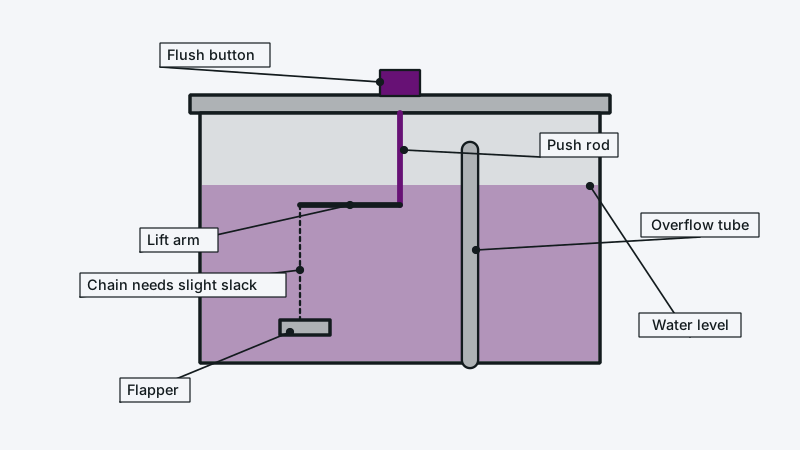
Start a flush button or handle repair by lifting the tank lid and watching the parts move as you push it. If the button moves but nothing lifts inside, the chain, lift wire or linkage has come loose. If the button is stiff or jammed, the mounting nut or the plastic stem is the fault. Each repair below needs only pliers and a few dollars in parts. The toilet repair overview gives the broader context.
Why will my toilet flush button not work?
The usual cause is inside the tank. The chain or rod that links the button or handle to the flapper has slipped off, snapped or tangled. Push the handle with the lid off and see whether the lift arm moves. If it does and the flapper stays down, reconnect the chain. If the arm does not move, the mount is loose.
Start with the simplest checks:
- The chain hook has come off the lever arm.
- The chain is too slack, so the handle moves but the flapper does not rise.
- The chain is too tight and holds the flapper partly open, so the toilet runs.
- The plastic nut that holds the handle to the tank has loosened.
- Mineral buildup has stiffened the linkage.
Reattach it, set the chain with roughly half an inch of play, and test. This fixes most handle complaints in a couple of minutes.
How do you replace a toilet handle with a chain?
Close the supply if you want a dry tank. Lift off the lid, detach the chain, then undo the mounting nut inside the tank (the thread is reversed, so it normally loosens clockwise). Draw the old handle out, put the new one in, snug the nut and hook the chain back on.
That reverse thread surprises people. Turning it the usual direction tightens it more. Hold the handle steady from outside while you work with a wrench on the nut inside. Make sure the new lever arm points in the right direction and clears the tank wall. Side mount, front mount and angle mount handles are different parts, so match the mount before you buy.
Flush a few times and check the chain length after each. A chain that catches under the flapper is the most common error after a handle swap.
How do you replace a toilet handle without a chain?
A number of toilets have a push button or a lift rod where others have a chain. These dual flush or top mount buttons connect to a flush valve with a rod or cable. Replace the whole button assembly with a matching kit, lift out the old one, and set the new one at the right height so the rod just touches the flush valve.
Each maker uses a different design, so read the model name inside the tank or on the bowl. For a push button that has gone stiff or sticky, try cleaning around the stem first. If it still jams, the cartridge or the seal under the button has worn and needs replacing as a set. Take a photo of the old parts for the store.
How do you fix a toilet that flushes slowly?
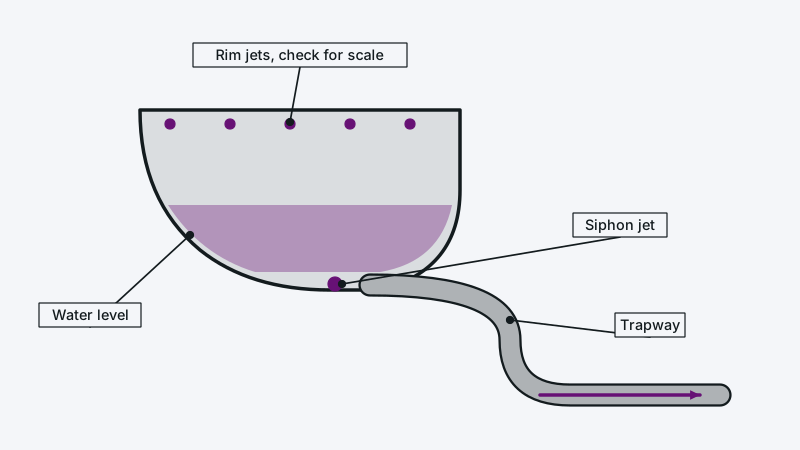
A weak flush usually traces back to a low tank level, a half-blocked rim or a clogged drain line. Check that the tank fills to the waterline mark, then look at the small holes under the bowl rim, which scale can block. If the bowl swirls weakly even then, the drain may be partly blocked.
A few causes, from simplest to hardest:
- The tank water level is low. Adjust the fill valve float up a notch.
- The rim jets are clogged with mineral scale. Valley water is hard, so this is common. Poke the holes clear with a straightened paper clip, or run vinegar through the overflow tube and let it sit before flushing. More detail is on removing hard water scale.
- The flapper closes too early because the chain is short. Lengthen the chain by a link.
- A partial blockage in the toilet drain or vent stack needs a plumber; the blocked toilet page has details.
Toilets from the 1950s and 1960s consumed more water per flush than current models, yet newer low flow toilets can flush weakly too if the passages are clogged.
How do you fix a toilet flush tank?
Most flush tank problems come down to three parts: the fill valve, the flapper and the overflow tube. Check the water level against the mark, test the flapper with the dye test, and look for cracks in the tank. A tank that refills constantly, hisses or sweats points to a specific part, and each has a cheap fix.
Do these in order:
- Water too high: drop the float until the level rests an inch or so under the rim of the overflow tube.
- Hissing after a flush: the fill valve is worn, see our guide to repairing a fill valve.
- Water seeping into the bowl: the flapper leaks, see toilet flapper repair.
- Water dripping from the tank edge: the tank to bowl gasket or bolts are worn.
The EPA notes that worn flappers are a common reason toilets leak silently, and suggests replacing them at least every five years.
How do you fix a toilet flush valve flapper?
Clean the flapper and seat, check the chain slack, and replace the flapper if the rubber is stiff, warped or sticky. Squeeze some food coloring into the tank and give it ten minutes. If the bowl water picks up color, the flapper or seat is not sealing, and replacing the flapper is the first fix.
If a fresh flapper still leaks, the seat itself is pitted or scaled, which means the flush valve needs work. Our page on toilet flush valve repair covers that next step, and some designs allow replacing a flush valve without removing the tank, which has its own guide.
How do you replace a toilet flush valve mechanism?
The usual sequence: shut the supply, drain the tank, loosen the supply line, unbolt the tank from the bowl and lift it away, remove the old flush valve nut, install the new valve and gasket, put the tank back and test. It takes about an hour for a first timer and needs care, because the tank is a heavy porcelain piece.
One repair guide describes the same sequence and adds that an overflow tube too short for the water level calls for a new flush valve assembly. If the tank and bowl are cracked, or the bolts are rusted solid, stop and call a plumber. Several toilet makers offer a kit that fits over the old valve and avoids lifting the tank, which is worth asking about.
How do you fix a loose toilet seat or a toilet that rocks?
A loose seat needs its two bolts at the back of the bowl tightened, with a hand on the nut underneath if required. A toilet that rocks against the floor needs the closet bolt nuts tightened evenly, a little on each side, and shim the base if the floor is uneven. If it still moves, the seal may be damaged.
A few cautions:
- Hinge bolts on a seat often have plastic nuts that strip. Replace the set if they spin.
- Do not crank the closet bolts down. Porcelain cracks quickly under uneven force.
- If the toilet rocks and you see water at the base, a wax ring may need replacing. See our guide to leaking toilet repair.
When should you call a plumber?
Bring in a plumber when a new handle does not cure the flush, the tank is cracked, bolts are seized, the shutoff valve will not close, or the flush stays slow with the water level and rim in good order. Those point to a partial drain blockage or a worn flush valve.
Once the problem goes beyond a chain and a nut, a plumber can visit and state the price in advance. Request a quote and describe what the handle and tank do when you press the button. How we work is explained on our homepage.
Questions people ask
Why does my toilet handle feel loose?
The nut that holds the handle inside the tank has probably worked loose, or the lever arm has slipped. Tighten the plastic mounting nut, remembering the reverse thread, and check the chain. If the plastic is cracked or stripped, buy a replacement handle in the same mount style and fit it.
Why does my toilet keep running after I flush?
Most likely the flapper fails to seal, or the chain snags. Look for a twisted chain, a warped flapper or a handle that sticks. If the water level is high, water flows into the overflow tube instead. Fixing the chain length and replacing a worn flapper solves most running toilets.
Can I replace the flush valve myself?
Yes, provided you can lift a tank off a bowl and tighten bolts evenly. It is an intermediate job, and plumbers charge for the visit, not the part. If the bolts are rusted or the tank is old and fragile, a plumber can do it faster and avoid cracking the porcelain.
How do I know if the problem is the flapper or the handle?
If the toilet will not start a flush, look at the handle and chain. If it flushes but keeps running, look at the flapper and fill valve. Pushing the handle with the lid off shows whether the chain moves, and the dye test shows whether the flapper seals.
Is a slow flush caused by hard water?
It can be. Mineral scale blocks the small rim holes and the siphon jet, and Valley water is hard in many areas. Check your utility's water quality report. Clearing the holes with vinegar and a wire is a safe first step. If it persists, a partial drain blockage should be checked by a plumber.
References
Updated