
A failed dip tube makes a tank water heater deliver lukewarm water or run out of hot water in minutes, because cold water enters near the top and mixes with the hot. Replacement is a small job, and one published guide listing the part at about $10 and part plus labor at about $150. It is a good fit for a younger heater. For others, see our water heater repair guide.
What does a water heater dip tube do?
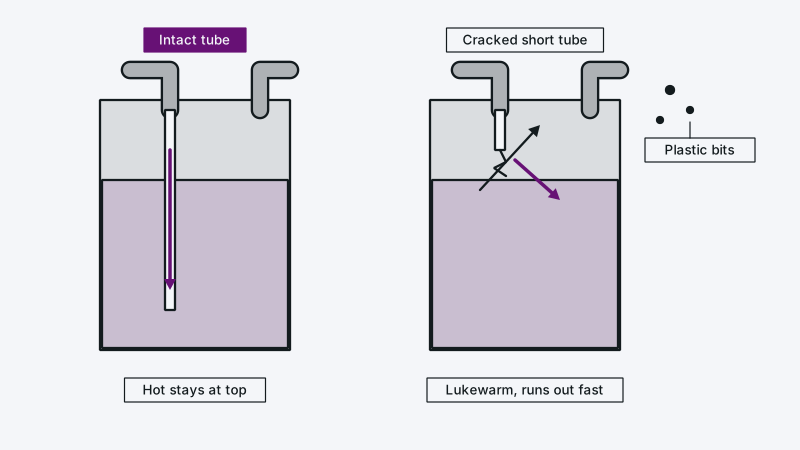
The dip tube is a long pipe that drops from the cold water inlet on the tank lid toward the floor of the tank. It makes incoming cold water enter low, where the burner or lower element heats it, while the hot water that has risen sits at the top, ready to leave through the outlet. Without it, cold and hot mix.
Heat rises, so a tank stratifies, with the hottest water at the top and the coldest at the bottom. The dip tube protects that layering. Cold water arrives at the bottom and pushes hot water up and out the top outlet. If the tube breaks off or cracks near the top, cold water pours straight into the hot layer and the tap water gets weaker.
Most dip tubes are plastic, and often form part of the inlet fitting. The bottom of the tube sits a few inches above the tank floor. Some heaters add a heat trap nipple at the inlet and outlet to cut standing heat loss, and these sit in the same area, so a plumber often replaces them together.
How can I tell the dip tube has failed?
Common signs are lukewarm water at every hot tap, hot water that runs out far sooner than it used to, and white or gray plastic flakes in faucet aerators and showerheads. If the shower runs cold within minutes while the burner or element works normally, that fits a cracked or short dip tube.
Those signs overlap with other faults, so a plumber rules out the alternatives:
- Thermostat set too low or failing. Bob Vila gives 122 to 140 degrees F as an ideal range.
- Lower element or burner problem. An electric tank with a dead lower element gives only a partial tank of hot water.
- Sediment. A tank full of mineral buildup holds less hot water than it used to.
- A mixing valve at the shower. Our page about a shower that has no hot water covers that one.
A clue pointing to the dip tube is debris. If you clean the screen on a faucet aerator and find small white or off-white pieces, a degrading tube is a likely source. The bits can also clog fixtures on the cold side, because the cold inlet feeds them. A tube that has fallen apart will keep shedding until it is replaced.
Hard water does not directly break a dip tube, but it wears down everything in the tank. Check your own supply in the water quality report from Burbank Water and Power, Glendale Water and Power or LADWP, depending on your address. Bob Vila notes that hard water can shorten a heater's life by two years or more.
How is a dip tube replaced?
The plumber first kills the power or gas and closes the cold supply, then drains part of the tank, disconnects the cold inlet pipe, pulls out the old tube or the fitting that holds it, and fits a new one cut to the right length. Then they reconnect the pipe, refill the tank, bleed the air out and test the heater.
The job in more detail:
- Safe shutdown. For gas, the control is set to off. For electric, the breaker is switched off before any work.
- Drain. The tank is drained down below the inlet and the water supply is closed.
- Remove the inlet. The cold nipple is unscrewed. The tube usually comes with it, or sits just inside.
- Fit the new tube. It is cut or matched to the original length. A new one is usually plastic too.
- Refill and test. Opening a hot tap lets air out as the tank fills. The plumber checks for leaks, restores power or gas and confirms the water is hot.
On a gas heater, restoring the burner involves relighting the pilot, which is another reason a plumber handles it. The work can go wrong if the threaded fitting is corroded and breaks. In that case the cost goes up, and the heater may be better replaced.
Because the tank is already open, a plumber might also look at the relief valve and the anode rod. A published guide puts an anode rod at about $20 to $50 for the part. Our page on pressure relief valve replacement explains the valve.
Is a dip tube worth replacing or should I replace the heater?
Replacing a dip tube is worth it when the heater is under about eight years old and otherwise sound. A published guide puts the cost near $150 with labor. If the tank is over ten years old, rusted, leaking or full of sediment, a new heater is usually the better use of money, since another part will fail soon.
Weigh it up like this:
| Situation | Likely best move |
|---|---|
| Heater 3 to 7 years old, no leaks | Replace the dip tube |
| Heater 8 to 10 years old, rumbling | Have the plumber inspect the tank |
| Heater over 10 years old | Compare repair against replacement |
| Tank leaking or rusting | Replace the heater |
Tank heaters are typically described as lasting 8 to 12 years. Our guide on how often to replace a water heater goes through the signs, and the prices are laid out under water heater replacement cost. If you are also thinking about a change of type, our page on tankless water heaters compares them.
To get a plumber to check a heater that has gone lukewarm, request a quote. Once you ask, we line up a nearby plumber to visit, and the price is put in writing ahead of any work. For the rest of what we cover, start at Lankershim Plumbing.
Questions people ask
How long does a dip tube replacement take?
Expect roughly one to two hours on a tank heater, covering the drain-down, the tube swap and the refill. A seized or corroded inlet fitting can lengthen the job. If the whole heater needs swapping instead, plan on half a day. Hot water is typically back the same day.
What should I ask a plumber before they replace a dip tube?
Ask them to confirm the dip tube is the cause and not a thermostat, element or sediment problem. Ask for a written price covering parts and labor, and what happens if the inlet fitting breaks. Look up their California contractor license on cslb.ca.gov, and find out what warranty backs the repair.
Does someone need to be home during a dip tube job?
Yes. An adult needs to be there to open up access to the heater and sign off on any change of plan. The water goes off for a stretch of the visit, and the gas or power is cut too. Clear a path to the heater and let the plumber know if the unit is in a locked garage.
Can a bad dip tube clog my faucets?
Yes. A plastic tube that is breaking down sheds small pieces that travel with the water, and they can collect in aerators and showerhead screens. If you keep finding white flakes, have the heater checked. Cleaning the aerators helps for now, but the pieces will keep coming until the tube is replaced.
Does a dip tube fail on a tankless water heater?
No. Tankless water heaters have no tank, so they have no dip tube. If a tankless unit gives lukewarm water, the usual causes are scale, flow that is too low for the burner to fire, or a sensor or gas problem. See our page on instant water heater repair.
References
Updated